Boosting employee wellbeing with benefits technology



Employee benefits technology can make it easier for employees to find and utilise the proactive wellbeing support needed to reduce sickness.
Preventing people from getting sick is 3-4 times more cost effective than investing in treatment1 . Employers are able to save £5 for every £1 invested in mental health2 and 4.4 days of productivity per employee, per year, when boosting engagement with physical health initiatives3.
It’s therefore unsurprising that employers are increasingly focusing on introducing a preventative benefits strategy. However, many employees still struggle to access support. Just 65% of employees know where to find benefits information4 and 80% do not fully utilise their benefits package5.
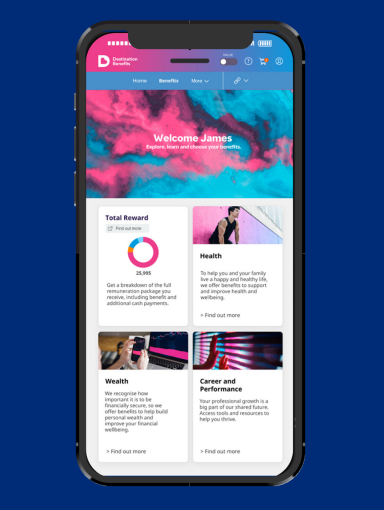
Fortunately, employee benefits software helps you to create a digital front door so employees can see all their benefits in once place. As well as improving engagement with benefits, this can also help you to boost employee wellbeing in the following ways.
1. Use employee benefits technology to signpost employees to preventative benefits
Although many employers are now introducing more preventative benefits, are employees aware that these exist? Especially when it comes to pre-paid preventative services.
For example, instead of starting a costly private medical insurance (PMI) claim for mental health counselling, are employees aware of the pre-paid counselling available through their Employee Assistance Programme (EAP)? If musculoskeletal (MSK) claims are soaring, can you signpost them to physiotherapy helplines to nip problems in the bud and prevent physical illness?
Instead of leaving employees to navigate their own way through the many benefits on offer, you can use employee benefits technology to not only centralise but also curate your benefits. This means as well as signposting employees towards mental, financial or physical health benefits, you can also proactively promote preventative benefits.
2. Hyper-personalise wellbeing with employee benefits technology
Personalising benefits can help increase engagement with benefits. 78% of employees with access to personalised benefits say these meet their needs, compared to just 56% of those without. Similarly, eight out of ten people with personalised benefits also believe their employer cares about their wellbeing, compared to just half of those who have no choice6.
Employers have increased choice in the past by introducing flexible benefits, that allow employees to choose between different benefits. For example, dental, optical, physiotherapy or cycle to work schemes. When managed offline, these are still relatively restricted because of the time taken to administer schemes and process selections. However, by introducing employee benefits technology such as Darwin, you can hyper-personalise wellbeing benefits.
3. Better communicate existing wellbeing benefits with employee benefits technology
An often-desired outcome of putting in place employee benefits technology is the 'thank you from employees for the ‘new’ benefits package. Often these are benefits employees always had access to, but because they hadn’t been promoted since the employees joined, they perceive them as new.
This also highlights how it’s often the way wellbeing benefits are being communicated, rather than the wellbeing strategy itself that needs improving. Fortunately, employee benefits technology also allows employees to start receiving targeted communications tailored to their needs. This could be a menopause benefit tailored by gender and age or an advanced cancer screening benefit for those employees at most risk. Combining benefits data with risk management strategies can help you to personalise and automate employee benefits communications even further.
Many wellbeing providers, also now offer additional services, information and apps, that could be of great use to employees. By using benefits technology, such as Mercer Marsh Benefits Benefits You App, employers can consolidate all this fragmented information into one source of truth. This will help employees to understand what they’re entitled to and how to select and tailor their benefits to their needs.
For example, individuals might not have been aware that they were entitled to a free private GP app, with their PMI, or aware financial wellbeing support could also be utilised by their partner. By using employee benefits technology to make sure employees are aware of everything they already have, you can boost wellbeing without having to spend more on your benefits package.
Personalising benefits can help increase engagement with benefits. 78% of employees with access to personalised benefits say these meet their needs, compared to just 56% of those without. Similarly, eight out of ten people with personalised benefits also believe their employer cares about their wellbeing, compared to just half of those who have no choice6.
Employers have increased choice in the past by introducing flexible benefits, that allow employees to choose between different benefits. For example, dental, optical, physiotherapy or cycle to work schemes. When managed offline, these are still relatively restricted because of the time taken to administer schemes and process selections. However, by introducing employee benefits technology such as Darwin, you can hyper-personalise wellbeing benefits.
The trusted benefits platform
- UK Digital Growth Leader, Mercer Marsh Benefits