
Outlook for 2026: Strategies for organisational effectiveness


Organisations may need to transform their people strategies to adapt to geopolitical risks
Organisations are navigating a range of challenges as a result of today’s geopolitical uncertainty, market volatility, shifting immigration policies, and evolving trade regulations. These dynamics, combined with ongoing pressure to manage costs, can lead to concerns among stakeholders and employees, potentially impacting overall engagement and productivity. In this environment, agility and adaptability are essential to maintain organisational effectiveness.
How can geopolitical uncertainty affect your employees and economic growth?
- Market volatility, tariffs, and economic pressures can increase operational costs, reduce customer spending, and disrupt supply chains. To respond effectively, organisations may need to accelerate digital transformation and automation efforts. Enhancing productivity might involve refocusing training. This can also include evaluating location strategies to move critical or manufacturing roles into markets with higher skill availability or reduced operating costs.
- More restrictive immigration policies and deal-based international relations can destabilise global talent flow and create local skills shortages, forcing organisations to develop country-specific talent strategies and contingency workforce plans.
- Subsequently, uncertainty about job security, risk of recession, relocation, and career and belonging questions can affect employee wellbeing, which may lead to reduced engagement and potential mental health issues (People Risk Report).
To help overcome disruptions and enhance organisational effectiveness, organisations can optimise the alignment between humans and automation — reducing costs while redeploying skilled talent to the most critical areas of the value chain in the right locations.
This combination creates the perfect storm for talent management — marked by uncertainty, rapidly changing skills requirements, limited mobility, and increasing operational costs. As a result, organisational effectiveness will drive more sophisticated workforce strategies in 2026 and beyond.
The journey to organisational effectiveness
Achieving organisational effectiveness in today’s turbulent environment requires a holistic perspective on the demands of work, the current talent supply, and the effectiveness of leadership in engaging, retaining. and rewarding workers.
Mercer sees this journey in three key phases:
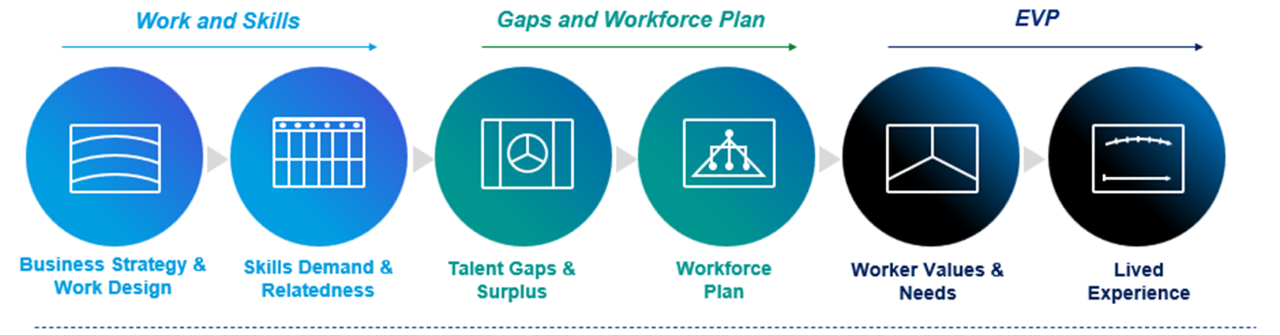
1. Work and Skills
- Business strategy and work design
- Skills demand and relatedness
2. Gaps and Workforce Plan
- Talent gaps and surplus
- Workforce plan
3. EVP
- Worker values and needs
- Lived experience
Phase 1: Navigating the Future of Work
To effectively navigate this dynamic environment, organisations need to align their work requirements with their evolving business strategy. This might include understanding shifts in demand and identifying opportunities for automation. This approach helps to determine the right size of the workforce, review the required levels of responsibility, and pinpoint the critical skills needed to support strategic objectives and enhance overall performance.
Work and skills checklist
- How have geopolitical dynamics changed your demand and business objectives?
- What opportunities can provide insight into delivering the most value to customers and their changing needs?
- What is the ideal size, structure, and working model for your teams?
- Which skills are most important now and for the future, and which can be deprioritised?
Phase 2: Bridging the talent gap with workforce agility
Organisations should evaluate their current workforce profile and identify any gaps relative to business requirements. This insight enables more informed workforce planning decisions, helping you unlock greater value while minimising business risks. A long-term view and actionable workforce plan can enable greater agility through a range of targeted talent interventions, including building, borrowing, or buying required skills, to ensure the organisation has the right skills in the right location at the right time.
Workforce plan checklist
- Where are your biggest skills gaps?
- What skills could accelerate reskilling?
- In which locations is it easier to recruit specific skills?
- How adaptable is your workforce to changing market conditions?
Phase 3: Elevating the employee experience
Given the uncertainty of today’s socio-economic and political situation, the “great resignation1 may be over. However, retention as well as recruitment of critical skills remains paramount to organisational success. Stability, pay equity, and progression opportunities continue to be key factors in attracting top talent. However, organisations need to understand and deliver to their workforce’s specific needs, including behavioural factors around culture, engagement, flexibility, and leadership to foster psychological safety and create more resilient and adaptable teams.
Your employee value proposition (EVP) checklist
- What truly matters to your employees? Start with employee listening.
- How can you reward critical skills and optimise the total rewards package?
- Which internal mobility opportunities should you encourage and how?
- What makes your organisation a more compelling place to work than your competitors?
- Are your leaders capable and confident to build and nurture resilient teams?

So, how can you get started?
Mercer can help you understand your organisation’s effectiveness with a fast-track benchmarking report. We review your workforce distribution, spans, and layers, and identify critical skills and high-value activities. From these insights, we can recommend practical, quick-win strategies to optimise your workforce approach.
Footnote
1. https://www.bbc.co.uk/worklife/article/20230731-the-great-resignation-is-over-what-does-that-mean
Our experts
Related solutions
Related insights
Related Case Studies
Related products for purchase
Curated