
Private Equity Value Creation through Talent Management


Many private equity companies have historically prioritised rapid cost reduction and financial engineering as key ways of generating additional value.
The typical value creation “playbook” for relatively short hold periods focused on moving fast and doing more with less. The aim was to scale the business and growing EBITDA through product and market expansion to accelerate returns on investment. Talent management and rewards were often seen as risks and costs to manage, rather than strategic enablers of value creation.
But in recent years, value creation plans in the private equity (PE) industry have had to evolve, with the process moving beyond the initial financial engineering and cost reduction levers.
Private Companies Board Fee Study
-
Do the skills and experience of the existing top team remain relevant and value-adding with extended hold periods? Going forward, do we need entrepreneurs or company managers?
-
How do we attract and retain new leadership outside of the existing top team where there are dilution constraints with the existing Management Incentive Plan (MIP)?
-
If an expected exit is now further away, how do we incentivise those outside of the MIP to deliver business and operational results that will ultimately deliver shareholder value?
-
What is the most appropriate organisation design and operating model going forward? How should this be staffed to support operational improvements and cash management?
-
How do we provide clarity around talent retention questions? These can include: career development, pay and progression opportunities, learning and development, and succession planning?
-
How do we ensure that our pay systems are robust, fair, and reasonable? What reputational risk might arise over pay transparency concerns?
-
What kind of culture do we want to foster and encourage in order to hire the best talent and maintain a proactive approach to executive recruitment?
As one of the leading global human capital consulting firms, Mercer can provide a blend of experienced professionals with strong track records on delivery, utilising our in-house pay and people databases, proven methodologies and experience to deliver practical workable solutions.
To provide further thought and insight we have prepared a number of short thought pieces setting out our views on the types of talent and reward management issues outlined above.
Private Equity Value Creation through Talent Management
Annual Pay Review - FAQs
As exit activity slows and holding periods increase, private equity firms must prioritise investing in top talent to sustain long-term revenue growth and successful execution. Recent economic volatility has prompted some caution. However, competitive cash compensation is essential for attracting the right skills and reducing turnover. Developing a compensation philosophy that balances targeted investment in key talent with an understanding of the broader business context and internal operations is crucial. It ensures the most efficient use of resources, enabling the business to deliver greater value.
A structured remuneration review cycle is necessary to ensure fair, competitive, and consistent pay decisions across the organisation. Ahead of year-end, this FAQ guide outlines how to ensure your annual remuneration review process connects your talent management strategy to your business and investment goals. It also provides practical guidance on how to approach salary and annual incentive payout decisions.
Ahead of the annual review, if not already in place, organisations should establish pay principles. These should provide clear criteria for determining salary increases and pay progression. Consider the “three Ps” – Position, Person, Performance:
- Position: What is the market rate for the position? Use salary surveys to understand the competitive landscape. Consider the availability of talent in the market. High demand and low supply may justify higher increases to retain critical talent. Additionally, consider the prevalence of hybrid roles in PE-backed companies. These require consideration of market rates for more than one type of role profile.
- Person: Assess the individual’s experience, technical expertise, proficiency, and skills compared to role requirements. Has the individual acquired new skills since their last review?.
- Performance: Review the employee’s performance against their goals and key performance indicators (KPIs). For high performers, evaluate whether this has been sustained over time. Consider both the what and the how. Has the employee demonstrated positive behaviours aligned with the organisation’s values?
- Ensure that salary decisions maintain fairness relative to peers with similar roles and experience. With pay transparency increasingly scrutinised and regulate, decisions must be defensible and supported by clear, explainable rationale.
For executive-level roles, published compensation surveys are the best market comparator source. Best practice is to select surveys that meet all or most of the following criteria:
- Published annually to capture changes in the market for talent
- Covers the majority of the relevant PortCo roles
- Reports a breadth of data to meet PortCo needs (e.g. specific geographies, industries, revenue sizes, etc.)
- Contains detailed job descriptions
- Provides summary statistics (e.g. quartile data)
Published compensation surveys are also typically used for wider workforce roles. Survey data can cover all industry for a general market rate view.Alternatively, sector-specific cuts (e.g. technology, retail, manufacturing) may be available to provide a more detailed lens.
Use salary surveys to benchmark salaries and pay structures. Adjust your pay review recommendations to ensure competitiveness, especially for high-demand skills. This is essential for effective talent management in private equity-owned companies.
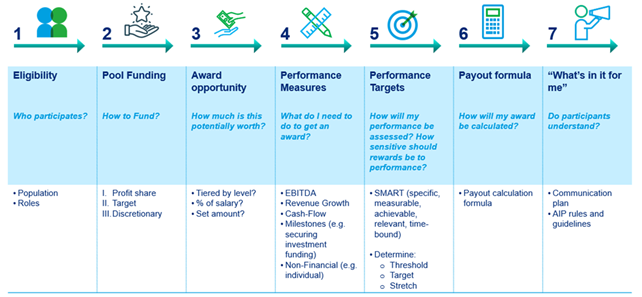
1. Eligibility.
Who participates?
· Population
· Roles
2. Pool funding.
How to fund?
· Profit share
· Target
· Discretionary.
3. Award opportunity.
How much is this potentially worth?
· Tiered by level?
· % of salary
· Set amount?
4. Performance measures.
What do I need to do to get an award?
· EBITDA
· Revenue growth
· Cash flow
· Milestones, e.g. securing investment funding
· Non-financial, e.g. individual.
5. Performance targets.
How will my performance be assessed? How sensitive should rewards be to performance?
· SMART (Specific. Measurable. Achievable. Relevant. Time-bound)
· Determine:
o Threshold
o Target
o Stretch.
6. Payout formula
How will my award be calculated?
· Payout calculation formula.
7. “What's in it for me?”
Do participants understand?
· Communication plan
· AIP rules and guidelines.
To determine if year-end funding is available for the annual incentive plan, a review is essential. You should review your company's financial position, budget, and strategic priorities. Engage with your Finance team to understand the overall financial results. This includes revenue, profitability, and cash flow. You should assess whether financial targets have been met or exceeded, as these often influence incentive funding.
- If the AIP pool is tied to a specific funding formula, confirm with your Finance team whether the funding condition has been met. This will help determine the funding available for distribution.
- If the AIP budget was approved at the beginning of the year, work with your Finance team to ensure the approved budget remains affordable. This should be based on the company’s financial performance, and whether the budget requires adjustment to reflect above target performance.
- If the AIP pool is determined discretionarily each year, compare year-over-year changes in key financial health metrics and award eligibility. Determine overall affordability and potential changes to funding levels.
In all cases, review any internal policies or governance guidelines that specify maximum payout limits or funding caps. Be sure to review any contractual or regulatory restrictions that could impact funding. Adjust the incentive pool if necessary, based on actual results versus projections. Confirm incentive funding with Senior Leadership and get the necessary approvals from the Board and/or Remuneration Committee, as applicable.
To kick off the annual pay and performance review process, plan ahead by defining stakeholder roles and responsibilities. Consider the RACI model – Responsible, Accountable, Consulted, and Informed. Create a timeline with key milestones and validate it with all stakeholders.
Ensure your pay principles are documented and up to date. You and your team should have a clear understanding of:
- Any changes to minimum wage or pay transparency regulations applicable to your markets.
- Incentive plan rules, including elements such as eligibility, target awards, payout formulas, thresholds, and any plan updates during the year.
Employee data should be current, including roles, tenure, salary details, and any employment changes. This includes promotions, role adjustments or changes to working hours. Gather relevant salary and total cash benchmarking data, conduct benchmarking, and analyse pay gaps. We recommend conducting this analysis 4-6 months before kicking off year-end.
Collate performance data which should include individual and team metrics aligned with company goals, progress on KPIs, and qualitative manager comments. Prior performance reviews or calibration notes provide helpful context to ensure a fair and considered annual pay review process. Budget and funding information as well as information on the company’s overall financial performance are also crucial. This covers revenue, profit, and results within specific departments or business units.
Fairness in annual pay distribution starts with clear performance criteria and payout guardrails. For annual incentives, transparent metrics and evaluation standards should be communicated upfront, with caps or guardrails in place to prevent excessive variability.
Any differentiation for performance should be clearly documented and communicated. Calibration sessions involving managers and leaders help review performance ratings collectively. This reduces biases and promotes consistency across teams.
Handling edge cases, such as recent promotions or pay adjustments, requires objective review and clear guidelines to ensure fairness.
Maintaining detailed documentation of assessments, calibration discussions, and decision rationales fosters transparency. Regular oversight before final approval helps ensure alignment with policies. Soliciting feedback from managers and employees post-process can identify areas for improvement.