
How endowments and foundations can advance their mission through investment


As more endowments, foundations and charities (E&Fs) look to progress their mission and values through investment portfolios, many are grappling with the most suitable approach.
In recent years E&Fs have increasingly moved to align their investments with the organization’s mission. They’re aiming to achieve not only financial returns but also targeted social or environmental outcomes.
One quarter of the E&F respondents to our 2023 E&F Survey said they use impact investing to align their portfolio with their mission. This trend, which has developed over time, gained further traction in the UK in 2023 when Charity Commission guidance encouraged trustees to use the investment portfolio as a key lever in achieving their purpose.
Yet as more E&Fs move in this direction – with benefits for reputation and fund raising – they may share the ambition of larger forerunners but often lack necessary scale and resources. We believe, though, that they can learn from the experience of the pioneering E&Fs. Doing so can help them to chart their own course and determine what resources they will need.
Different paths to impact
Pioneers in the UK and US have taken several different paths. Some have aligned investments with mission by focusing on investing for impact across themes – such as climate, health etc. – that are core to their mission. Other impact-led approaches concentrate on place-based investments in the E&F’s backyard, such as building affordable houses. Other E&Fs may make investments that catalyse transition to a more sustainable economic, social and environmental future.
It seems that a wider set of E&Fs has taken steps toward values alignment by excluding companies that don’t reflect their values, such as those linked to tobacco, controversial weapons, fossil fuels etc.
Taking an impact investing approach has become easier due to the proliferation of dedicated impact strategies, although many are in private markets meaning E&Fs must account for an illiquidity trade-off. Illustrating this growth, the UK impact investing market grew from £19.3 billion in 2021 to £76.8 billion in assets by the end of 2023, according to the Impact Investing Institute.
Three initial steps
-
Understanding the intersection of mission alignment versus goals.Aligning investment portfolios with mission and values involves agreeing beliefs and impact themes while targeting an opportunity set that will make it possible to maintain strong financial returns.
-
Setting the strategic parameters of impact investing.Successful implementation of objectives requires impact goals to be set alongside traditional risk/return metrics, with an emphasis on a long-term approach. Establishing “success” metrics at the onset of an impact investing program is crucial.
-
Codifying governance arrangements.Strong governance is important for achieving goals alignment. Boards should consider establishing clear investment beliefs and guidelines that reflect the organisation’s values, ensuring that all stakeholders – staff, investment managers, external advisors and donors – are aligned.
Choosing your sustainable investment persona(s)
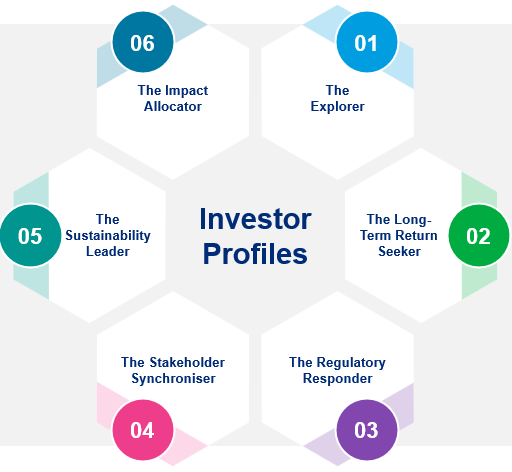
As investors explore how to align their mission and investments, choosing your sustainable investment persona(s) can be a useful exercise. The personas enable asset owners to consider which profiles they identify with, helping owners to understand the drivers, ambitions and practical actions that are right for them. You may find that one suits you perfectly or that you identify with elements of more than one. The graphic below illustrates six personas that Mercer has identified, which we describe as follows:
- The Explorer represents owners starting to develop sustainable investment objectives, or those seeking to review a long-standing approach.
- The Long-Term Return Seeker represents investors taking a long-term approach when setting their investment strategy, with a consistent time horizon that they apply to solving sustainability challenges.
- The Regulatory Responder represents those responding to (typically increased) regulatory expectations governing sustainable investment.
- The Stakeholder Synchroniser represents investors seeking to align their investment strategy with the expectations or values of their wider stakeholders.
- The Sustainability Leader represents investors who want to take the lead in sustainable investment and support broader market development and innovation.
- The Impact Allocator describes those investors who wish to focus on both financial returns and intentional social or environmental impact.
IMPORTANT NOTICES
References to Mercer shall be construed to include Mercer LLC and/or its associated companies.
© 2025 Mercer LLC. All rights reserved.
This contains confidential and proprietary information of Mercer and is intended for the exclusive use of the parties to whom it was provided by Mercer. Its content may not be modified, sold or otherwise provided, in whole or in part, to any other person or entity, without Mercer’s prior written permission.
Information contained herein has been obtained from a range of third party sources. While the information is believed to be reliable, Mercer has not sought to verify it independently. As such, Mercer makes no representations or warranties as to the accuracy of the information presented and takes no responsibility or liability (including for indirect, consequential or incidental damages), for any error, omission or inaccuracy in the data supplied by any third party.
This does not constitute an offer or a solicitation of an offer to buy or sell securities, commodities and/or any other financial instruments or products or constitute a solicitation on behalf of any of the investment managers, their affiliates, products or strategies that Mercer may evaluate or recommend.
For the avoidance of doubt, this paper is not formal investment advice to allow any party to transact. Additional advice will be required in advance of entering into any contract.
The findings, ratings and/or opinions expressed herein are the intellectual property of Mercer and are subject to change without notice. They are not intended to convey any guarantees as to the future performance of the investment products, asset classes or capital markets discussed. Past performance does not guarantee future results. Mercer’s ratings do not constitute individualised investment advice.