

Impact on DB plan discount rates
While further cuts are widely expected in 2026, the number of cuts and magnitude will depend on incoming economic data (primarily inflation and job market).
The benchmark interest rate (“Fed Funds rate”) is the overnight interest rate at which banks borrow and lend to each other. The Fed dramatically raised these very short term rates by 500 bps+ to a target range of 5.25-5.50% at the end of 2023. These increases came right after the height of the COVID crisis, in part to slow down inflation and rein in spending. With consumer spending slowing and a softening job market in 2025, the Fed has begun lowering these rates.
Roughly speaking, longer-term yields are equal to the expected average of future short-term rates plus a premium for locking money away for a longer period. So while short-term rates move immediately, longer-term yields are driven more by what the markets expect future Fed policy to be.
To help gauge the potential impact on pension discount rates, we take a closer look at three rate cuts over the past 25 years (Figure 1.), all occurring during recessions: the dot-com bust and 9/11 in 2001, the great financial crisis of 2007/2008, and the emergence of COVID in 2019/2020.
Fed interest rate actions, cutting, or raising the overnight bank borrowing rate, do not necessarily have an immediate or one-to-one impact on the much longer maturity discount rate used to determine defined benefit plan liabilities.
Figure 1. Fed Rate v Pension Discount Rate: January 2001 to September 2025
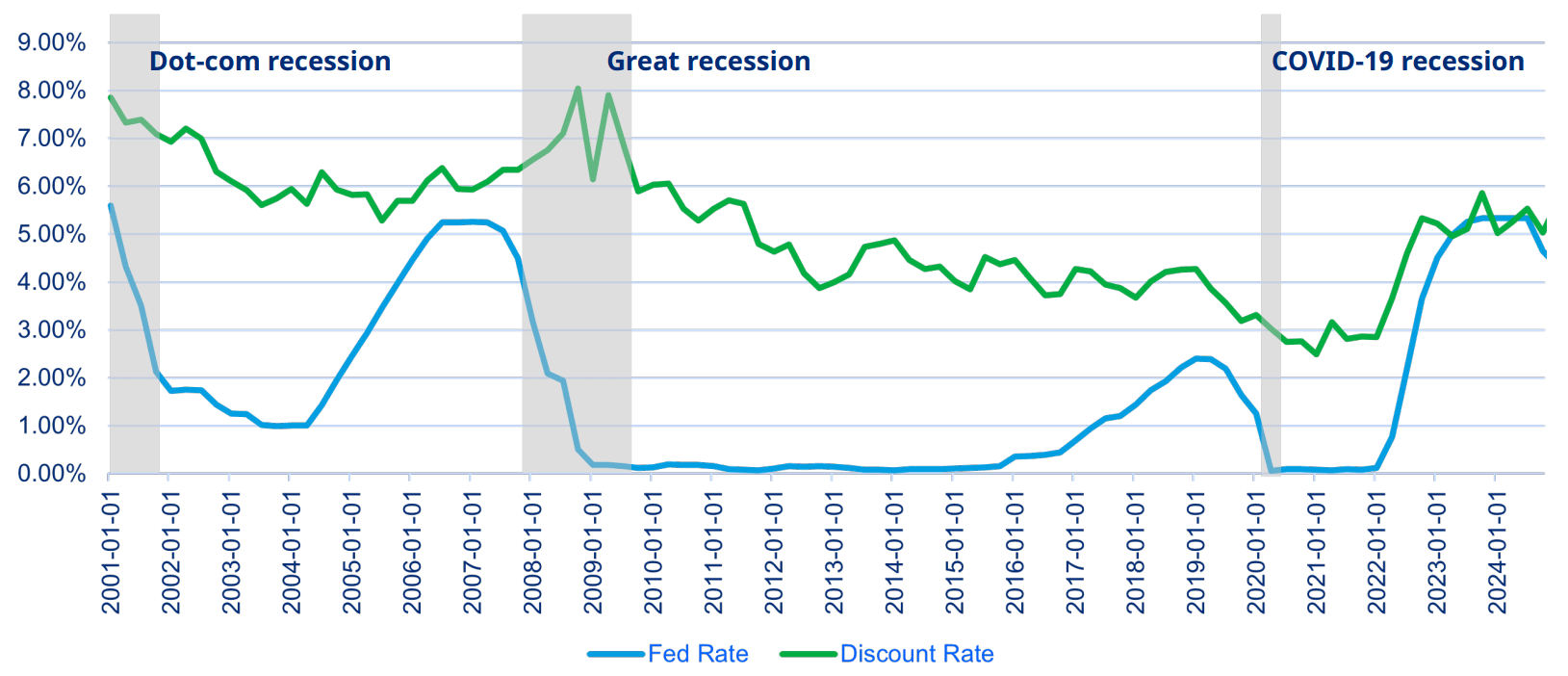
During the dot-com bust and again in 2019, the pension discount rate declined, though not as steeply or as quickly as the Fed Funds rate1. Many defined benefit plans were under-hedged with regard to interest rates during this period, and saw their funded status deteriorate significantly. In 2007/2008, the pension discount rate actually increased as credit spreads ballooned, before gradually falling over the subsequent decade. Sponsors who had effective liability driven investing (LDI) programs in place generally protected their funded status well.
Granting that we are not currently in a recession, what might happen to pension discount rates as a result of the most recent and anticipated future Fed cuts? Forecasting the future path of interest rates (and pension discount rates) is notoriously difficult. For example, just a little over a year ago in September 2024, the Fed cut rates by 50 bps. Over the subsequent year, pension discount rates rose. We believe long term rates are more likely to fall rather than rise from here over the longer term. But anyone making a call on the direction of rates over the short term does so at the risk of ignoring a long history of unpredictability. The actual path of rates is unknown and the impact on funded statuses will vary based on the specific defined benefit plan. If pension discount rates do decline, plans that are under-hedged with regard to interest rate risk are likely to see their funded status decline, resulting in a potential increase in cash contribution requirements and higher pension expense.
The funded status of US defined benefit plans rose to a 16-year high of 113% in 2023, falling back slightly through the end of Q3 2025 to 109%. These improvements were largely driven by a strong equity performance and a sharp rise in pension discount rates. If we begin to see a decline in pension discount rates, plans could see funded statuses erode.
Interest rate risk is generally considered an uncompensated risk. Accepting greater funded status volatility (by being under-hedged with respect to interest rates) does not lead to improvements in funded status. We believe that all plans should be reviewing their interest rate risk exposure and taking action to mitigate it where possible2.
December Fed Rate Cut: Impact on DB plan discount rates
1 Chart data source: Federal Reserve, Fed funds effective rate quarterly, not seasonally adjusted. Pension discount rate, Mercer calculation for a sample defined benefit plan taken at each quarter end using proprietary corporate AA spot rate curve.
2 In 2024 we published a similar paper. This paper has been updated to reflect updated data and market conditions.
Please see important notices