2025 CFO Survey Results: Pension oversight, investments, & governance

Pension oversight, investments, and governance: Managing investment and governance risk is top of mind.
Part 1
Part 2
Part 3
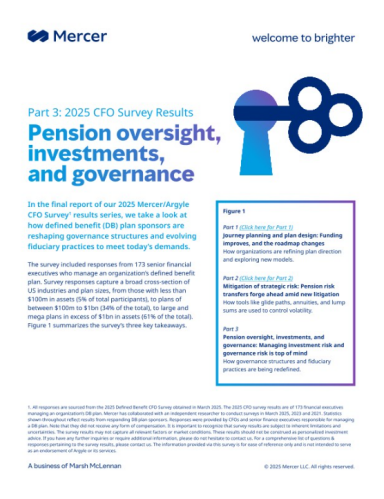
Pension oversight, investments, and governance: Managing investment risk and governance risk is top of mind: How governance structures and fiduciary practices are being redefined.
Pension oversight, investments, and governance: Managing investment risk and governance risk is top of mind
The management of DB plans is becoming more complicated. Oversight is rapidly changing as some companies adapt to regulatory complexity, market volatility, and heightened stakeholder expectations, according to the 2025 Mercer/Argyle CFO Survey.
Outsourced Chief Investment Officer (OCIO) frameworks continue to pick up steam. 39% of those participating in the survey this year are operating under a full OCIO model, up from 31% in 2023. This model has gained traction among mid-sized plans aiming to streamline operations, reduce the administrative burden of DB plan management, and potentially improve investment outcomes. In addition to a fully outsourced solution, another 22% of organizations have established partial outsourcing for the investments or operational oversight of their DB plan.
Reflecting the growing need for support, only 39% of respondents reported high confidence in their organization's ability to manage the DB landscape in-house, a slide from previous years, and over half of survey respondents said they have difficulty completing plan changes promptly. Common reasons for this could be lack of time, training, and resource turnover, all factors that make it increasingly difficult for teams to keep pace with the evolving demands of plan management.
To address these challenges, some organizations are also turning to technology. Dashboards, scenario models, and predictive analytics are quickly becoming go-to tools in pension governance. These features provide real-time plan-funded status, asset allocation, and projected liability information. Some firms set triggers to execute glide-path shifts based on funding levels or interest rate movements. Others are using scenario stress testing to evaluate how macroeconomic variable shifts affect long-term solvency.
In our interview with Sandra D. Pham, Vice President of Finance, People & Culture at Kaiser Permanente, she highlighted the importance of governance as a cultural anchor: “Governance reflects our values; it’s how we fulfill our pension commitments.” Her comment reflects the growing expectation that pension oversight serves not only to meet compliance requirements, but also to act as a model for organizational integrity.
Investment strategy is another area that continues to be dynamic. Over half (50.3%) of respondents indicated that they had changed their investment strategies in light of discount rate changes and market volatility.
Common changes include:
- Increasing fixed-income exposure to lengthen the duration.
- Reducing exposure to public equity.
- Expanding investments in private credit or infrastructure.
- Using interest rate derivatives to hedge liabilities
Beyond allocation, organizations should prioritize the proper documentation of investment activities. This could involve establishing dedicated pension committees that bring together expertise from finance, legal, HR, and treasury. Generally, these committees meet quarterly to review plan metrics, approve plan changes, and evaluate plan performance by third parties. Several organizations are beginning to mandate fiduciary training for committee members in response to changing Department of Labor audit expectations.
Boards play an active role in pension management oversight. What was once primarily led by HR is increasingly being driven by finance, with CFOs now taking the lead in speaking to the board on pension strategy. These discussions frequently revolve around risk transfer possibilities, long-term funding consequences, and how pension choices coincide with more general capital management goals.
Marco Rossi, Head of Finance at Siemens Healthineers, offered his perspective: “Strong governance breeds confidence; it’s our anchor for tough choices.” His remarks point to the increasing weight placed on informed, collaborative decision-making structures, especially as plans approach major changes such as de-risking or termination.