
A new model for a new workforce: Rewiring the support functions for human–machine teaming


Across every industry, AI is reshaping workforce decisions, accelerating processes and transforming how value is created. Leaders are bullish and optimistic — Oliver Wyman Forum and the NYSE research shows that 96% of CEOs now see AI as more of an opportunity than a risk. But that optimism hasn’t yet translated into adoption or readiness.
The infrastructure that supports work hasn’t kept pace with the reality of human-machine teaming.
The functions designed to enable work — HR, technology and finance — were built for stability and efficiency, and assumed that a predictable, fixed set of services was sufficient to support business needs. They were not designed for a world of fluid roles, intelligent systems and dynamic, cross-functional teams. They certainly weren't designed for agility, self-improvement or perpetual transformation.
Former assumptions and ways of operating are no longer fit for purpose. As organizations adapt internally and move to enable human and machine-teaming, the goal is shifting:
- From maintaining functions to enabling outcomes.
- From delivering services to empowering adaptive teams.
- From internal alignment to business integration.
In our recently published paper, we called for a new HR vision and introduced the concept of stewards of humanity. People functions are being challenged to serve as the stewards of humanity in the age of AI, but that mission can’t succeed in isolation. Laying the foundation for true human–machine teaming requires a broader reorientation across all support functions: a reset of purpose, pace and accountability.
This paper introduces a conceptual blueprint for that change.
Why the traditional operating model no longer fits
Support functions were never designed for the era of intelligent collaboration. HR, IT and finance were built around a predictable model of work — one defined by fixed roles, linear processes and siled expertise.
Their strength was in delivering services, often transactional, usually at scale: payroll on time, systems online, budgets approved, policies enforced. This probably explains the 1:100 ratio for HR employees to the rest of the workforce we've seen for decades. It was arguably sufficient in a predictable, static and transactional operating model. As organizations face mounting pressure to deliver profitable growth, this linear approach no longer scales.
The emerging organizational model is anything but predictable. The rise of human–machine teaming introduces new dynamics: adaptive teams, intelligent systems as collaborators, and business value measured in speed, learning and cross-functional outcomes. In this environment:
- Job architectures are giving way to more flexible models designed around skills and capabilities.
- Digital, operational, and human capabilities must be fused into unified teams.
- Agile pods form and reform around problems and opportunities.
- Outcomes, not activities, define direction.
- Machines are now participants in the flow of work.
Legacy structures are already straining under this shift. Service delivery models lack the flexibility to meet the needs of fluid, fast-moving teams. Accountability breaks down when work is shared across functions, and between humans and machines. Silos, as always, slow everything down. Human and machine solutions are designed separately, without a leader to make sure they work together to amplify capabilities.
This gap is reflected in early data from Mercer’s 2025 HR Operating Model & Practices survey:
- 67% of organizations say their HR KPIs are only somewhat aligned to broader business priorities
- And while almost half of HR leaders report they are considering an operating model transformation in the next 18 months, the drivers are many — from cost and agility to organizational growth, tech integration, and strategic repositioning
To keep pace, HR, technology and finance functions need a new operating model — one designed not just to serve the business, but to evolve with it.
The human–machine team: A new unit of work
The real opportunity of AI isn’t just automation, but amplification.
At its best, a human–machine team is not just a pairing of people and tools. It’s a purposeful collaboration between human capability and machine intelligence, designed to amplify strengths, accelerate outcomes, and spark new forms of innovation. It’s a new way of working, and one that demands rethinking how we define roles, design teams, and measure value.
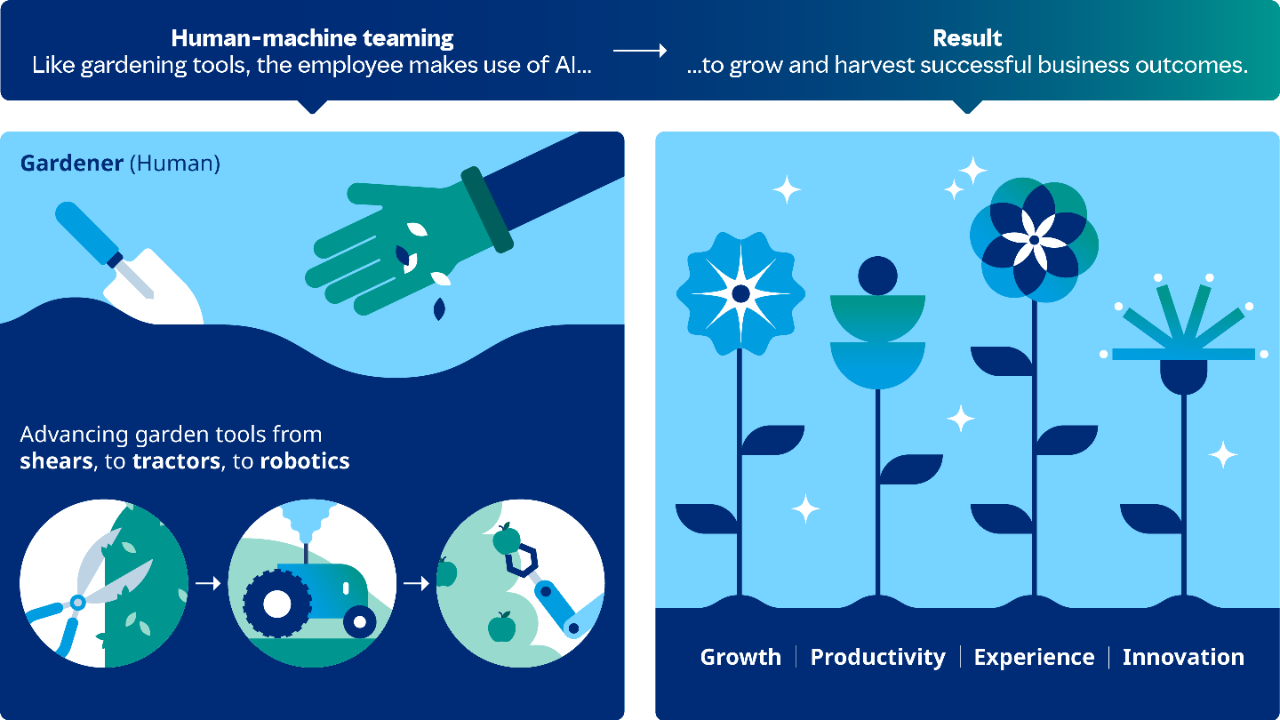
The goal isn’t to replace humans with machines or to throw AI at every task it can technically perform. It’s to ensure that humans and machines are each doing what they do best. The real power comes when they do it together — when AI augments human potential, and human intent guides machine precision. That’s where true amplification happens. And that’s where outcomes accelerate.
That means reserving human capacity for judgment, empathy, and creative problem-solving — while assigning machines to automate, analyze, and adapt in ways that enhance team performance. It also means moving beyond the mindset of tools or systems and toward an integrated model where technology is a trusted teammate, not a distant utility.
Done well, human–machine teaming unlocks greater speed and accuracy in decision-making; more adaptive, skills-based approaches to work; and a greater capacity for innovation. And it’s already happening.
From call centers using AI copilots to frontline roles augmented by computer vision, organizations across industries are shifting toward teams where work is shared between people and machines. This dynamic will continue to evolve; what starts as augmentation may quickly move to autonomous execution. Today’s talent dispatchers may work alongside AI agents; tomorrow’s may manage a portfolio of autonomous sourcing tools as a strategic talent architect. Today’s total rewards specialists may use AI to benchmark compensation and personalize benefits; tomorrow’s may oversee intelligent systems that model tradeoffs, predict employee needs, and dynamically tailor total rewards strategies at scale.
The implications are clear. Redesigning work for this model, and keeping it optimized, isn’t a one-time exercise. It’s an ongoing capacity to continuously reinvent work. One that requires deep understanding of human behavior, machine potential, and the actual mechanics of how work drives business value.
That reality sets the stage for what must come next: rewiring the enterprise systems that support, design, and enable these teams at scale.
A rewiring of our most critical support functions
To enable human–machine teaming, HR, IT and finance now face a dual challenge: They must evolve into human–machine teams themselves, while also enabling those teams across the business.
This creates something of a paradox. How can these critical growth functions help others transform if they haven’t been transformed internally? It’s a chicken-or-egg moment, and one that requires action now.
These functions have historically been organized around internal efficiency, structured for delivery of services like payroll, system uptime, budget allocation, or compliance. But as legacy orientations, they were built for stable jobs, predictable workflows, and clear handoffs.
Supporting a new model may ultimately involve restructuring in HR, IT and finance, but the initial, critical work is in reorienting those teams now.
If HR aims to be the steward of humanity in the forthcoming era — balancing productivity with impact — it's essential to uphold dignity, trust, and purpose as fundamental principles. This should be done while integrating intelligent systems more deeply into the fabric of work. But this isn’t HR’s burden to carry alone.
Instead of having HR with arms into the business, organizations need a cross-functional team oriented toward the business. HR, IT, and finance would all sit there. Yes, it's a radical shift in enabling how functions operate: from siled, internal service providers to integrated, business-facing strategic partners. That's the whole point; a reframing of purpose from back office to business activators.
This team would be responsible for driving the success of human and machine teaming, operating as embedded, co-equal partners, working holistically across disciplines, oriented toward business value, and empowered to act at speed.
brings the human insight — designing roles, experiences, and ethics into every team
enables intelligent infrastructure — building secure, scalable platforms that power agile work
activates strategic agility — allocating capital, scenario planning, and creating investment pathways for transformation
Five principles to consider
As organizations rewire for human–machine teaming, they’ll need a shared foundation and common set of design principles that prioritize business outcomes, human values, and continuous adaptability.
These five design principles may serve as a blueprint:
-
Value-ledBegin with business outcomes, not processes.
-
Team-orientedDesign roles around teaming, not tasks.
-
Machine-empoweredAssign machines to automate, augment, and adapt.
-
Human-designedPreserve space for judgment, care, and trust-building.
-
Continuously transformingTreat transformation as a service, not a one-time redesign.
What comes next: From principles to practice
Human–machine teaming is no longer a future-state concept; it’s a current-state challenge. And while AI may be the accelerant, the success of this transformation will hinge on something more fundamental: how we design, support, and scale the work itself.
As a steward of productive humanity in the age of AI, HR must put itself in position to guide ethical AI adoption, uphold trust and purpose, and drive human potential in a world increasingly shaped by machines. But HR cannot shoulder that responsibility alone. Our most critical support functions must show up together in cohesive teams built for speed, adaptation, and shared accountability.
That shift will take intention. It requires more than change management; it requires changefulness. And it will require resetting long-held expectations about the role of support itself.
Organizations that begin this work now, rewiring their infrastructure with agility, alignment, and intelligence, will be best positioned to shape the future of work. And survive it.
Mercer is already helping clients build this next-gen operating model, with:


The future of work won’t be powered by technology alone. It will be built — and made more human — by design.
Let’s build it together.
HR Transformation Solutions and Innovation Leader, US & Canada, Mercer
Partner, HR Transformation, Mercer
Senior Associate, Mercer