
Marsh CFA Institute Global Pension Index 2026


An analysis of 55 retirement income systems around the world


Strengthening retirement income systems in an ageing world – Australia achieves its first A grade
Ageing populations, shifting workforce dynamics, and heightened geopolitical uncertainty are reshaping the retirement landscape. Now in its 18th edition, the Marsh CFA Institute Global Pension Index provides an established tool for benchmarking and comparing the world's retirement income systems, offering a structured framework to help decision-makers navigate the challenges ahead with greater clarity and confidence.
In 2026, Australia achieved an A grade for the first time. It is one of only six systems globally, and the only A-graded system in the Pacific region. Australia’s result reflects particularly strong sustainability and integrity scores, with its overall index value rising to 80.6 (up from 77.6 in 2025).
This year, the index benchmarks 55 retirement income systems worldwide with the addition of Dominican Republic, Kenya and Qatar. Together, these systems – covering 66% of the world’s population – spotlight both challenges and opportunities for policymakers.
How the index assesses retirement income systems
Systems are assessed across three pillars:
- Adequacy (40%)* – delivering meaningful retirement incomes today
- Sustainability (35%)* – remaining resilient for tomorrow
- Integrity (25%)* – earning the confidence of those who depend on it
* Percentages here correspond to the weighting given to the overall score.
Together, they capture the balance every system must strike. The report evaluates each system across more than 50 indicators to provide actionable insights.
2026 Deep Dive
Each year, the index features a deep dive into a topical issue. In 2026, the focus is on the impact of ageing populations on retirement income systems and how policy responses to demographic challenges can help develop sustainable policies in the long run.
Download the report to explore the 2026 findings and compare results across all benchmarked systems.
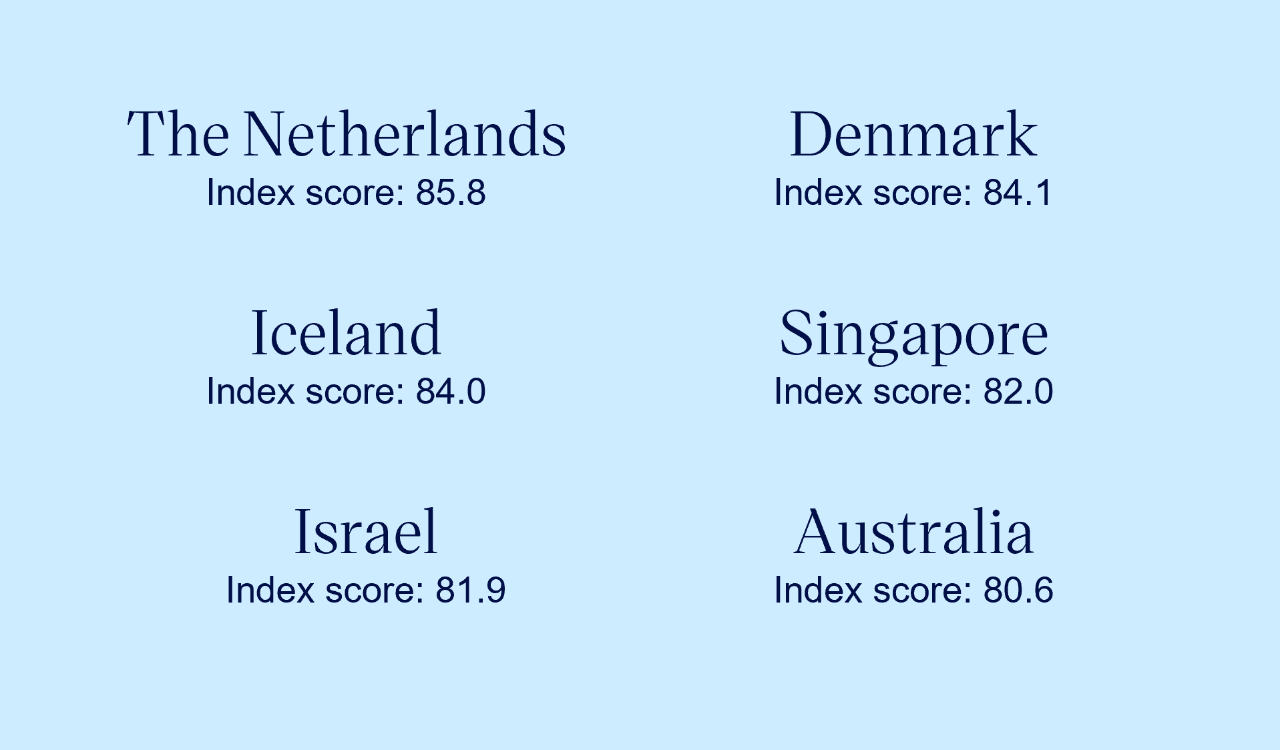
2026 A-grade retirement income systems
Netherlands
Denmark
Iceland
Singapore
Israel
Australia
Top 3 rated systems for each sub-index
-
Adequacy
How much do you get?
1. Kuwait
2. The Netherlands
3. France21. Australia
-
Sustainability
Can the system keep delivering?
1. Denmark
2. Iceland
3. The Netherlands5. Australia
-
Integrity
Can the system be trusted?
1. Finland
2. Norway
3. Singapore7. Australia
People are living longer, work is changing, and the pressures on retirement income systems are growing. The question is no longer whether systems need to evolve, but how quickly and how effectively they can do so.
Lead author, Partner, Investments and Retirement, Marsh
Overall grade for each retirement income system

 MCGPI A Grades
- China C+ (60.6 ▲)
- Hong Kong SAR B (71.2 ▲)
- India D (46.8 ▲)
- Indonesia C (50.7 ▼)
- Japan C (58.0 ▲)
- Korea (South) C (56.4 ▲)
- Malaysia C+ (61.1 ▲)
- Philippines D (49.2 ▲)
- Singapore A (82.0 ▲)
- Taiwan C (59.7 ▲)
- Thailand C (52.2 ▲)
- Vietnam C (54.6 ▲)

- Austria C (56.9 ▲)
- Belgium B (68.1 ▼)
- Croatia B (66.1 ▼)
- Denmark A (84.1 ▲)
- Finland B+ (77.6 ▲)
- France B (70.3 =)
- Germany B (67.9 ▲)
- Iceland A (84.0 =)
- Ireland B (69.7 ▲)
- Italy C (57.4 ▲)
- Netherlands A (85.8 ▲)
- Norway B+ (77.0 ▲)
- Poland C (58.4 ▲)
- Portugal B (67.3 ▼)
- Spain C+ (63.3 ▼)
- Sweden B+ (78.8 ▲)
- Switzerland B (73.6 ▲)
- United Kingdom B (71.6 ▼)

- Botswana C (57.0 ▼)
- Israel A (81.9 ▲)
- Kazakhstan C+ (64.8 ▼)
- Kenya C (53.1)
- Kuwait B (72.9 ▲)
- Namibia C (57.5 ▼)
- Oman B (69.9 ▲)
- Qatar B (66.0)
- Saudi Arabia B (73.2 ▲)
- South Africa C (50.4 ▼)
- Türkiye D (46.6 ▼)
- United Arab Emirates B (70.0 ▲)

- Argentina D (43.7 ▼)
- Brazil C (57.0 ▲)
- Chile B+ (79.2 ▲)
- Colombia C+ (63.3 ▲)
- Dominican Republic C+ (61.4)
- Mexico B (71.2 ▲)
- Panama C+ (62.0 ▲)
- Peru C (55.7 ▲)
- Uruguay B (69.7 ▼)

- Australia A (80.6 ▲)
- New Zealand B (71.4 ▲)

- Canada B (70.6 ▲)
- United States of America C+ (61.6 ▲)
The impact of ageing populations on pension systems
Many nations are facing an ageing population due to falling birth rates and increasing life expectancies. These demographic changes have profound long-term implications for retirement income systems:
- Potentially increased costs of pension provision as individuals live longer,
- Funding pressures as working age populations proportionately decrease,
- The need for more flexible pension designs to accommodate phased retirement and non-traditional employment,
- Intergenerational tensions as adequacy and sustainability of systems are reviewed,
- Shifts in investment strategies as a greater proportion of the US$70 trillion in global pension fund assets moves toward defensive positioning.
Policymakers who recognise these demographic consequences have a window of opportunity to implement evidence-based policy responses, which we explore in our report.
The central insight is straightforward: demography is our destiny, but policy responses are choices. While demographic changes are inevitable, the path forward is not predetermined. Those systems that consider and address the demographic consequences today will be much better positioned to develop sustainable retirement income policies that provide adequate and equitable retirement security for generations to come. The evidence shows that with clear objectives, thoughtful funding, and flexible design, leading pension systems can and will remain resilient.
In Australia, these dynamics are already shaping the policy conversation. The Index points to opportunities to lift household savings, review how the age pension means test treats the family home, and sharpen the focus on superannuation's core purpose of delivering retirement income.
The Index makes clear that without meaningful reform – clearer system objectives, stronger funding, and more flexible product design – too many people will reach retirement without the security they need.
Managing Director of the Research & Policy Center, CFA Institute
Meet our lead author and contributors
This content on this website is provided for informational purposes only and should not be taken as advice or recommendation to buy or sell any specific investment product or services, including Mercer’s investment management services, or to enter into any portfolio management mandate with Mercer.
Any investment carries inherent risks and you should carefully consider your own investment objectives, financial situation, and needs before making any investment decision.
Past performance is not an indication of future performance.