
Re-thinking the 60/40 multi asset portfolio allocation

31 October 2025
The 2020s has been more volatile for investment markets than any decade in the last 50 years. When both equities and bonds fall in tandem during market stress, the traditional 60/40 portfolio may no longer provide adequate protection.
It’s probably time to move beyond traditional 60/40 equity-bond portfolios within multi-asset portfolios. That was the key message shared by Andrew McDougall, Mercer’s Head of Multi-Asset, at the recent Mercer Private Markets and Alternatives Masterclass, held in collaboration with Portfolio Construction Forum, for financial advisers and wealth managers.
While this simple diversification strategy may have worked in the past, the shift from negative to positive equity-bond correlations appears to be leading to higher portfolio volatility. That can mean reduced compound returns and weaker portfolio performance.
Looking ahead, return prospects for the traditional 60/40 mix are likely to be significantly lower than historic averages.
So how can financial advisers help clients build portfolios that seek to withstand market volatility and achieve above average returns? McDougall suggests they can consider creating a multi-dimensional portfolio, diversifying into private markets and alternative assets
Key takeaways
The case for private markets is based on three investor needs:
-
Hunt for return
-
Need for diversification
-
Evolution of capital markets
Search for higher returns in a low-yield environment
With public market returns coming up short in recent years, some investors appear to be shifting their focus to private markets. Whether they’re balanced or growth-focused investors, the search for capital appreciation and income is increasingly challenging.
“In the last five years, we’ve seen fixed incomes repriced. Ultimately, equities have continued to grind higher, effectively “borrowing” from and reducing future expected returns,” McDougall explains.
While the range of outcomes for a simple 60/40 portfolio with public market exposure is still diverse, the future appears underwhelming. And private markets may offer a return premium that investors are finding increasingly compelling.
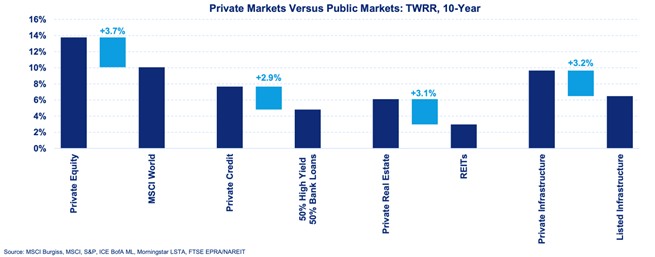
Private equity and private credit have consistently outperformed their public market equivalents over the long-term. For example, the chart above shows private equity returns over the last 10 years outperformed public equity by 370 basis points net of fees. And this trend is steady across the major private asset classes, with outperformance sitting at around 3% over the same period.
“While private markets may be a great asset class for long-term return potential, I believe its most important role in a portfolio is diversification,” says McDougall.
Stay diversified as traditional correlations shift
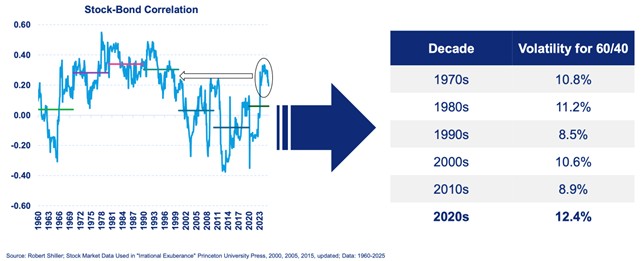
Traditional 60/40 portfolios have been more volatile this decade than any decade since the 1970s. That volatility can lead to a weaker investor client experience.
"If every asset in a portfolio is on a constant upward trajectory, that could be a sign of a lack of diversification," says McDougall. This risk was heightened after the Global Financial Crisis, when investors searched for a broader range of asset classes.
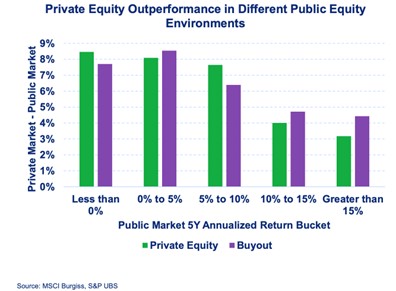
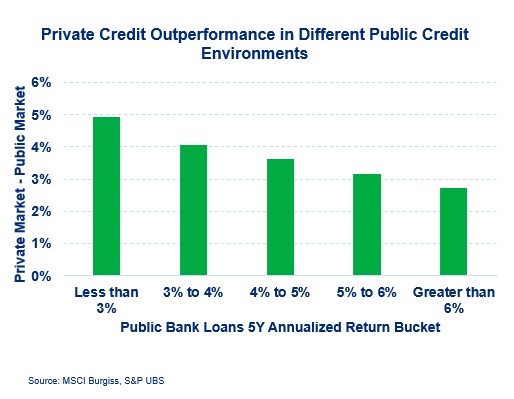
Diversification can be the key to compounding returns over the medium and longer term. Private markets can provide an alternative source of returns, which can be helpful during public market downturns.
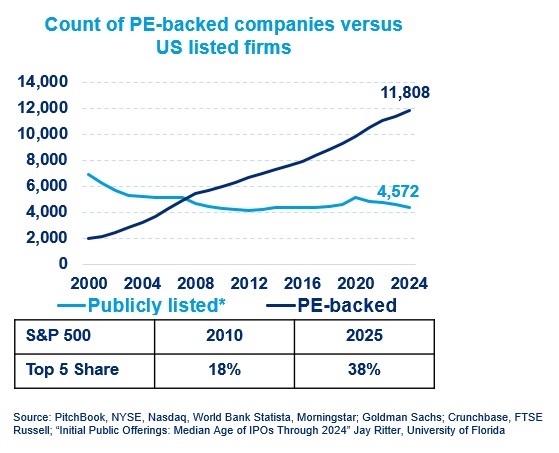
Access more opportunities as capital markets evolve
Start with client objectives
Private markets may expand the opportunity set for clients. The asset class looks to cover a broad variety of risk/return and liquidity profiles to suit different investor objectives – from income-oriented direct lending to growth-oriented opportunistic real estate.
Financial advisers need to consider what is right for their client’s objectives and risk appetite. This is where investment manager selection and operational due diligence can be important.
If a manager shows you their past measures and they don't show you how operational excellence is transforming the company, then I'd question whether to work with them or not.
Global Solutions Chief Investment Officer, Mercer