
Digital assets or digital distractions? Lessons for financial advisers from Mercer’s Matt Scott

30 October 2025
Social media is driving the adoption of cryptocurrency among young investors. But do digital assets actually add value?
Nearly four in five (79%) of 18 to 41 year olds[1] in the United States turn to social media for financial advice. And research shows[2] that Australians under 35 are more likely to listen to an ‘influencer’ than a financial adviser.
The cryptocurrency conversation appears to have moved beyond whether financial advisers should engage – the question now is how.
Younger investors are increasingly drawn to cryptocurrencies and tokenised assets, from property to commodities. For financial advisers with millennial and Gen Z clients, ignoring digital assets is no longer looking viable.
So how can financial advisers seek to help clients find a place for digital assets in their portfolios?
The starting point may be separating genuine innovation from expensive complexity.
At Mercer’s recent Private Markets and Alternatives Masterclass, held in collaboration with Portfolio Construction Forum, Matt Scott, Director of Strategic Research, suggested financial advisers evaluate value creation, understand what they’re buying and seek to position digital assets appropriately within portfolio construction.
Key takeaways
Smart digital asset investing can involve:
-
Evaluating the underlying value of the asset
-
Understand what is being bought before allocating
-
Position digital assets as tactical alpha opportunities
Apply the value creation test to digital asset claims
Many digital asset applications can be expensive solutions to problems that don’t exist. Financial advisers could start by asking whether a technology actually creates value – or simply adds complexity.
“When an asset doesn’t have any intrinsic value, you can see a complete collapse in its price,” Scott warned. The 97% collapse in the non-fungible token (NFT) market from its 2021 peak illustrates the point.
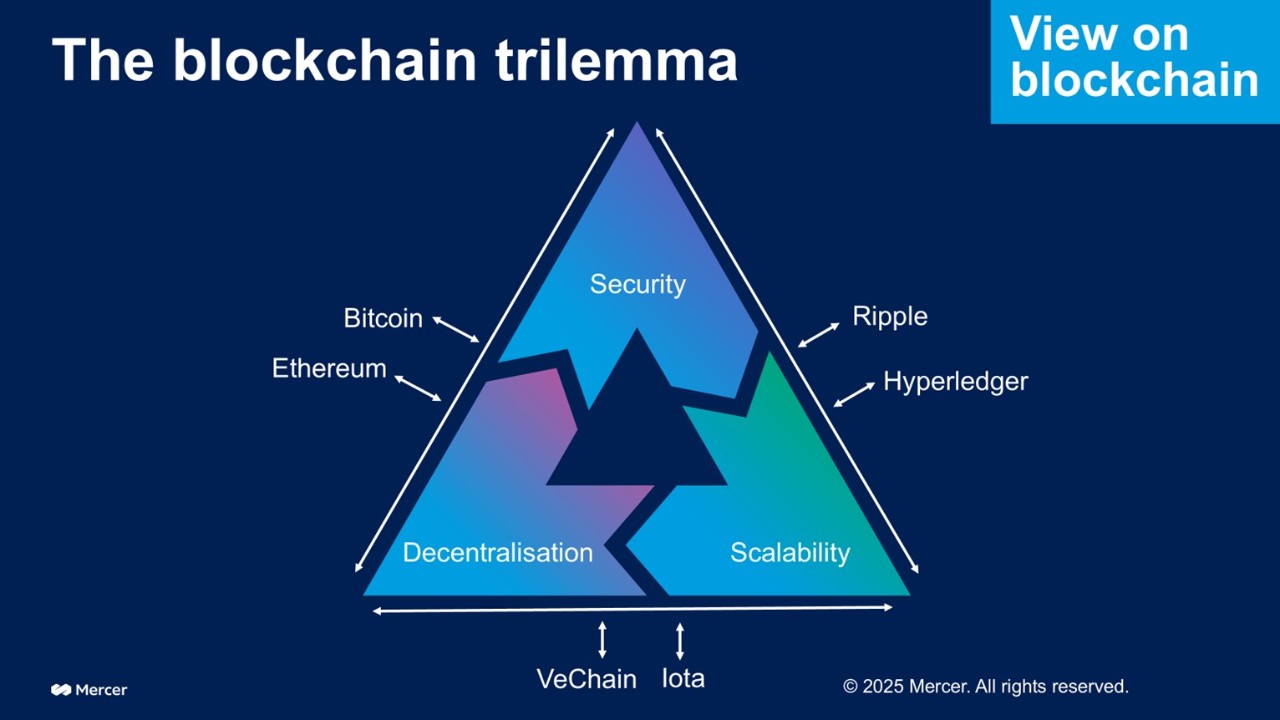
Even when digital assets claim real-world use, they can face another hurdle: technical constraints. The so-called “blockchain trilemma” means systems can only achieve two of three goals – decentralisation, security or scalability. Bitcoin prioritised security and decentralisation, sacrificing scalability entirely.
Understand what you’re buying
The cryptocurrency narrative promises to revolutionise finance. But before financial advisers allocate client capital, they could look to separate marketing from measurable outcomes.
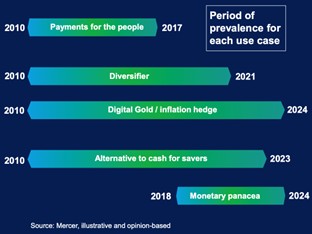
Bitcoin is a case in point. Its original promise – to democratise money and reinvent payments – has long since collapsed under technical and energy constraints.
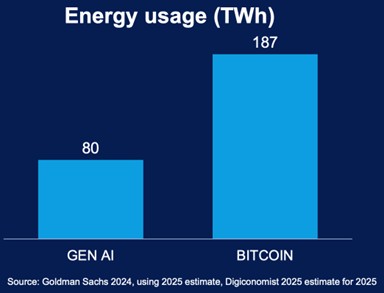
Bitcoin consumes the equivalent of roughly two-thirds of Australia’s annual electricity generation (around 280 terawatt hours in 2023-24) and has twice the energy footprint of generative AI. Its scaling issues forced a retreat from payments to a narrower use case: a “store of value,” or digital gold.
That comparison doesn’t hold up in Scott’s view.
“If you’re comparing bitcoin with gold as an investment, bitcoin comes up short,” Scott said.
Gold’s market capitalisation is ten times larger, its 2,500-year track record shows how it behaves through economic cycles and it has intrinsic value. Bitcoin’s 15-year history offers no clarity on how it performs in prolonged recessions. Its value depends entirely on continued belief that it functions as digital gold.
Bitcoin was once considered a diversifier, but since 2021 it has traded more like a technology stock – undermining its defensive role.
The takeaway for financial advisers: ask what problem each digital asset seeks to solve, and whether it adds real value to the portfolio or just expensive complexity.
Position digital assets as tactical alpha
There is a Gutenberg moment in the world right now: people aren't listening to the financial services industry. They're looking to alternative voices.
Director of Strategic Research, Mercer
That means financial advisers could try and position digital assets carefully. For most clients, small, tactical allocations make sense – treating digital assets as speculative opportunities, not core or defensive holdings.
There are limited exceptions. Tokenisation, for instance, uses blockchain to represent ownership of illiquid assets such as private equity or real estate. In theory, it could make assets with decade-long lockups and million-dollar minimums accessible to smaller investors. A $50 million office building divided into tradable tokens could, in principle, create liquidity where none existed before.
Scott describes tokenisation as “off to a cold start,” that financial advisers could consider watching the space, not rushing in.
Invest with critical discipline
Client interest in digital assets does not appear to be going away – and financial advisers who handle it well could approach it critically, not dismissively.
Digital assets can be treated as speculative alpha opportunities, not strategic portfolio staples. Financial advisers can look to separate hype from genuine innovation, consider size allocations for their client’s risk profile, and be clear with clients about what these assets actually represent.
With strategic research and multi-asset portfolio construction expertise, Mercer can help financial advisers evaluate digital assets through the same disciplined lens applied to any investment category.
That discipline could turn digital asset conversations from reactive responses to client hype, into proactive, evidence-based portfolio decisions.
[1] Source: Forbes Advisor 2024
[2] Source: The Association of Superannuation Funds of Australia (ASFA), media release published 29 July, 2024