
Drive agility and productivity with Work Design
Redesign work for the AI era by optimizing how people and technology work together.
According to Global Talent Trends 2026, 61% of executives in Asia believe that redesigning work to incorporate AI and automation is the initiative that can unlock workforce agility, release capacity and ultimately drive business returns, yet only 39% of Asian executives believe their workforce can do this optimally.
While AI’s role in the future of work is undeniable, just 51% of C-suites in Asia feel their businesses are equipped to reinvent themselves in response to evolving AI capabilities.
For many, work design is the missing piece. Mercer’s Work Design methodology combines consulting, workforce intelligence, and AI-enabled technology to help organizations take a work-first approach – not jobs – to human-AI teaming and workforce transformation.
How Mercer Work Design helps organizations in Asia through a three-step approach
- 1 Step 1
- 2 Step 2
- 3 Step 3
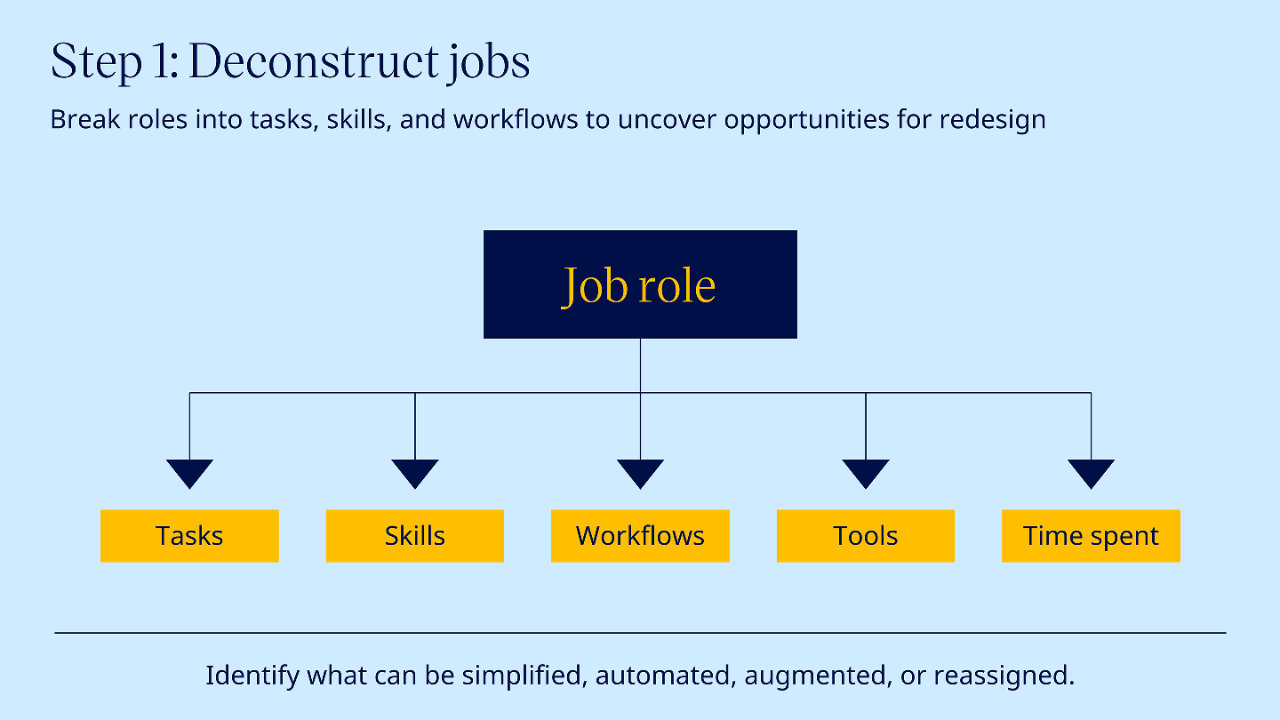
Deconstruct Jobs
Break jobs into activities and tasks to understand how work gets done today to identify repetitive work, emerging skill requirements, critical activities, and tasks that may be better suited for automation, AI enablement, or redeployment.
Redeploy tasks
Reimagine how work can be delivered more effectively across people, AI, automation, shared services, outsourcing, internal talent marketplaces, or other talent models.

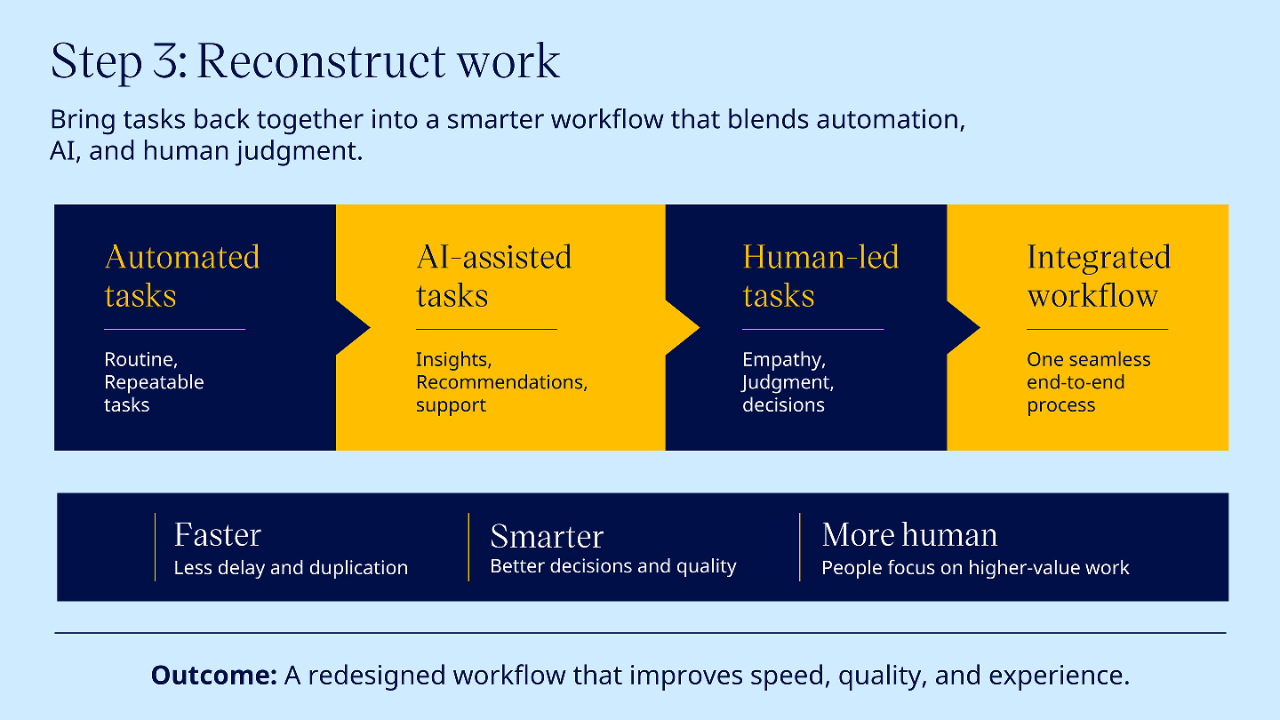
Reconstruct work
Redesign roles and workflows around the future work model, including identifying sunsetting and emerging skills, aligning redesigned roles to career pathways, compensation and performance management.
Marsh goes beyond redesign to deliver workforce value with jobs and skills data and assessment capabilities
Throughout the process, Mercer pairs its Work Design tool with its jobs and skills data, including the Mercer Job and Skills Library, providing organizations with a scalable and data-driven foundation to accelerate your workforce transformation.
We then quantify potential impact across capacity release, productivity improvements, workforce effectiveness, and cost savings. These insights are translated into practical recommendations and prioritized actions that deliver measurable business value.
Finally, redesigning work without building skills slows adoption and raises risk. Mercer embeds our proprietary skills‑assessment tool – directly connected to the Mercer Job and Skills Library – to pinpoint gaps and guide targeted re/upskilling. The result: faster adoption, lower implementation risk, and a workforce that can sustain continuous change across diverse markets.
A global financial services organization partnered with Marsh to redesign work across critical bank loans roles facing growing skills gaps, high attrition, manual processes, and increasing client service demands.
Using Mercer’s Work Design methodology, we analyzed four key roles across 92 tasks to identify repetitive activities, workflow inefficiencies, and opportunities for automation, centralization, and task redistribution.
We then redesigned how work was delivered across people, automation, and operating structures by:
- Centralizing 29 tasks.
- Shifting 17 tasks to more appropriate role levels.
- Identifying 68 tasks for full or partial automation.
The organization also redesigned roles around stronger skill specialization, faster onboarding, and more targeted reskilling and upskilling pathways. This led to:
- 45%–50% release of senior workforce capacity.
- Approximately 50% time savings.
- 40%–50% cost savings per role.
By redesigning work at the task level, the organization created a more scalable operating model while improving workforce efficiency, agility, and service delivery.
The organizations seeing the greatest returns from AI are redesigning work itself by aligning people, automation, and skills around business outcomes.
Singapore organizations are navigating a double whammy: AI accelerating faster than most can keep pace with, and geopolitical uncertainty reshaping the business landscape. Incremental adjustments won’t be enough. Staying competitive means rethinking how work gets done: bringing together human judgment and intelligent automation to build a workforce truly ready for what’s ahead.
Turning work redesign into business transformation
Redesigning work is only the beginning. To drive long-term business impact, organizations must connect work redesign to the broader workforce systems that shape performance and growth, including:
- Skills and capability development.
- Rewards and compensation including how performance in new roles will be assessed and compensated.
- Talent marketplace, career pathways and performance management.
Marsh helps you adapt to rapid digital adoption, navigate local labor practices, and win the talent race by aligning people, technology and skills to business priorities.
Why Marsh
Partnering with Marsh helped us redesign work in a way that improved both workforce efficiency and employee experience. By modernizing workflows and introducing smarter automation, our teams were able to focus on higher-value work while gaining clearer opportunities for growth. The impact was significant: A 28% increase in capacity, a 39% boost in productivity, and US$140 million in annual workforce cost savings.