Operationalising a skills-powered organisation


What does it take to bring a skills-powered strategy to life? Not just as a visionary concept but a functioning reality embedded in the day-to-day systems, decisions and digital tools that shape how work gets done?
For years, organisations have talked about using skills as the currency of work. And with good reason. A growing body of evidence shows that skills-powered organisations (SPOs) perform better across a range of business outcomes — from improved retention to increased agility and cost efficiency. But for many HR and technology leaders, turning this ambition into operational reality remains an uphill climb.
The business case is clear, and most leaders already see the value. In Mercer’s 2025 Global Talent Trends Study, half of HR leaders identify skills shortages as one of the top threats to their businesses in the year ahead. Among organisations farther along in their journeys toward integrating skills into their talent strategies, 92% report positive business outcomes — from productivity gains to increased agility and engagement. And the 2024–2025 Skills Snapshot Survey observed that nearly 70% of employers have identified the most critical skills for their departments, while about half have established a working skills library.
Where most organisations get stuck is in the operational middle ground. How do you translate strategy into systems? How do you take the architecture you’re building — your skills library, your frameworks — and apply it to everyday decisions about people and work?
In this article, we examine why the shift to skills is gaining urgency, why many companies stall in the implementation phase, and what steps HR and tech leaders can take to break through. Using Mercer’s Infinity Loop for Digital Transformation as a practical lens, we walk through the technology capabilities needed at each stage — strategy, deployment and betterment — and offer a focused, realistic playbook for digitally enabling your skills-powered strategy.
Understanding the opportunities and challenges
Proven benefits of a skills-powered organisation
The shift toward SPOs is no longer relegated to early adopters. Skills-based talent practices are increasingly recognised as a structural advantage for navigating workforce disruption, aligning talent to business strategy and future-proofing the enterprise. Mercer’s 2024–2025 Skills Snapshot found that organisations with integrated skills frameworks experience significantly higher employee retention, and our 2025 Global Talent Trends Study showed that more than 40% of skills-forward organisations are already realising benefits such as faster talent deployment, improved engagement and better skills transparency.
Real-world evidence supports these insights. The graphic below demonstrates how organisations that embrace skills-powered strategies achieve tangible, measurable business outcomes across productivity, agility, cost savings, employee engagement and profitability.
Leading on Skills Pays Off
ROI Achieved
Global insurer

gain in productivity of data scientists over 18 months
ROI Achieved
Consumer Products company

FTE equivalent saved
ROI Achieved
Large bank savings

per person by upskilling and reskilling talent to redeploy talent from ‘sunset jobs’ to ‘sunrise’ jobs
ROI Achieved
Global consumer goods company

eNPS score recorded by employees
ROI Achieved
Oil and gas company

improvement in profitability per rig after 12 months
Common challenges in operationalising an SPO
The benefits of becoming an SPO are clear, but the execution is often anything but straightforward. Companies frequently face significant barriers in translating strategy into practice. Mercer’s 2024–2025 Skills Snapshot highlighted several widespread concerns among HR leaders in this regard, including limited HR capacity or capability (40%), excessive change (38%), lack of funding (30%) and risk of increased costs (30%).
Properly implemented technology solutions can help mitigate these barriers, expanding HR team capacity through automation, pacing organisational change through staged digital transformation and clearly demonstrating ROI to alleviate stakeholder cost concerns.
Yet digital transformation itself introduces another layer of complexity. Even with substantial investments in technology, many organisations struggle to realise their digital capabilities. When it comes to enabling skills-powered career frameworks with digital solutions, we find the following common challenges:
-
Experience architecture (user journeys and usability)Systems are rarely designed around the end-user experience. When tracking or developing skills, employees may struggle with complex interfaces, and managers may find it difficult to glean actionable insights about team capabilities.
-
Solution architecture (digital toolset and capabilities)Organisations frequently maintain overlapping or redundant tools without understanding which tool best supports skills-based processes. This can lead to confusion, inefficient investments and lower user adoption.
-
Technical architecture (data flow and integration)Many organisations lack a unified source of truth for skills data, resulting in inconsistent data flows, fragmented insights and reduced accuracy for workforce planning.
-
Inaccurate or outdated job profilesGaps in jobs data, especially job descriptions and requirements, can lead to a lack of understanding about what talent the organisation has and what it needs. This issue is compounded when different HR COEs maintain job, employee and/or candidate information in siloed databases, typically with different access controls.
-
A lack of a standardised skills taxonomyGaps in skills data can also cause problems, as terminology and relevance can vary widely across different departments. What’s more, skill requirements can change rapidly due to technological advancements and market demands, making it difficult to maintain up-to-date data. Ensuring that skills data are accurately assessed and validated can be challenging, leading to over- or underestimating capabilities. Furthermore, determining who owns the skills data (for example, HR, department heads) may lead to conflicts and a lack of accountability for data quality.
-
The technology marketplace can be overwhelmingMercer’s recent Skills Technology and Adoption Report found that 60% of organisations lack a clear digital strategy for connecting talent to work via talent marketplaces. With so many solutions available, selecting and deploying the right technology becomes daunting, leading many organisations to delay action or implement fragmented, partial solutions.
-
Underutilisation of existing skills data and systemsMany organisations that have invested heavily in core HR) and talent technologies fail to leverage their full capabilities. Mercer’s Skills Technology and Adoption Report found that 66% of organisations have yet to optimise their existing HR technology architecture for effective skills management.
How to operationalise an SPO — Essential digital resources
To move beyond strategy and into sustained execution, organisations must invest in the right digital infrastructure. A successful skills-powered organisation creates the systems and experiences that organise, understand, deploy, grow and reward those skills in an integrated, scalable way.
In our Mercer Skills Technology Marketecture, we’ve outlined five essential capabilities that form the digital backbone of any operationalised skills-powered strategy. Each plays a critical role in enabling organisations to put their skills philosophies into practice.
-
Organise skills:The foundation of any SPO is a clear and consistent definition of skills and how they relate to jobs and job profiles. This begins with job architecture management (to allow for mapping skills to jobs) and skills framework (a manageable taxonomy or ontology). These tools help create the connective tissue between jobs and the skills required to perform them, enabling consistent application across talent processes.
-
Understand skills:To make skills actionable, organisations need visibility into their workforces’ current and future skills and external labour markets . This requires skills inference, validation and market intelligence. Understanding skills at scale helps organisations close gaps, plan for future needs and make better decisions about hiring, upskilling and redeployment.
-
Deploy skills:To realise the benefits of agility and cost-efficiency, organisations must activate skills in the flow of work through talent marketplaces and internal mobility platforms and by matching people’s capabilities to roles, positions, projects or gigs. These tools unlock the full value of internal talent, improve responsiveness to change and reduce dependence on external hiring.
-
Grow skills:An SPO actively develops its people through personalised, data-driven growth opportunities, supported by learning platforms, coaching/mentoring and career pathing. Growth-oriented platforms address current skills gaps and also improve engagement, retention and equity in development opportunities.
-
Reward skills:To reinforce desired skills and behaviours, organisations must link performance and compensation directly to skill outcomes. This includes compensation benchmarking, skills-based rewards, certification and recognition platforms. By tying rewards to skills, organisations send a clear signal about what capabilities matter and encourage continuous development in areas that support strategic priorities.
Practical steps for operationalising an SPO
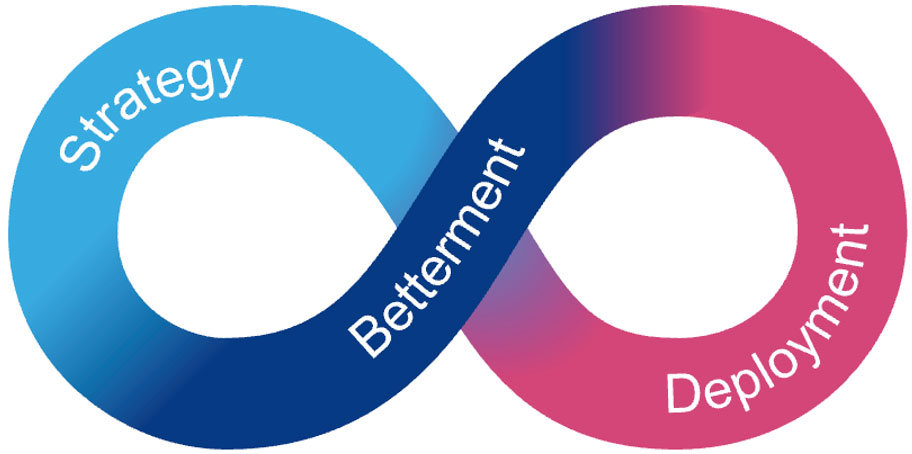
Strategy is positioned at the top left, indicating the initial phase where planning and strategic thinking occur.
Activation is in the centre, symbolising the implementation of the strategies developed.
Deployment is located at the top right, representing the execution and delivery of the activated strategies.
Betterment is at the bottom left, suggesting a focus on improvement and refinement of processes based on feedback and results.
The design emphasises the cyclical nature of these stages, highlighting that the process is ongoing and iterative, with each phase feeding into the next to foster continuous improvement. Additionally, there is a note indicating "Tech Implementation," which likely refers to the technological aspects that support each stage of the process.
Each stage — Strategy, Deployment and Betterment — offers a structured lens for activating the right digital capabilities at the right time, grounded in the realities of your workforce, architecture and business priorities.
Let’s break them down:
- 1 Step 1
- 2 Step 2
- 3 Step 3
Strategy — Laying the digital groundwork
Bringing a skills-powered vision to life starts with foundational design. Before any systems go live, organisations need to understand evolving work, strategic context and what talent capabilities will be most valuable in the future.
This means:
- Aligning on a future-fit job architecture and skills framework, including clear decisions about job families, proficiency levels and types of skills to be tracked (core, technical, leadership, etc.)
- Mapping those skills to roles using a scalable ontology and consistent language across departments and systems
- Engaging internal stakeholders — especially in high-need business units — to identify pain points, key performance indicators and future-state goals
- Revisiting talent processes, such as workforce planning, recruiting, performance management and internal mobility to ensure the organisation is equipped to use skills data meaningfully
- Auditing existing technology systems and conducting a fit-gap analysis to determine whether current tools (for example, HR, LMS , career platforms) can support the framework or whether new solutions are required
At this stage, developing a clear deployment roadmap that identifies in-scope populations, systems and use cases for each phase is critical. Your strategy should also include an early design of your skills governance model to ensure ongoing accountability.
Deployment — Turning architecture into action
Deployment is where your digital foundation meets reality. The goal is to embed the skills framework into daily work, talent processes and decision-making.
This phase starts with establishing data governance for jobs and skills. Organisations should develop clear policies, protocols, and responsibilities for keeping job profile data and skills data up to date, improving data quality, ensuring compliance, and fostering collaboration across departments to enhance their data governance frameworks. Thanks to advancements in artificial intelligence (AI), this has become infinitely easier, with capabilities such as:
- Automated data cleaning and anomaly detection to ensure accuracy
- Use of natural language processing, including inferences, to unify information from various sources and map skills to job roles
- Assessment and screening of people’s skills and qualifications relative to job requirements
This phase also includes:
- Digitally configuring your skills model within your platforms to ensure data flows cleanly and users see immediate relevance to their roles and development
- Implementing or optimising your talent marketplace, internal mobility platform, or career pathing tools to match talent to opportunities in real time
- Building strong change enablement plans to drive adoption, starting with executive sponsors and then cascading training and messaging to HR, managers, and employees
- Integrating skills insights into talent processes and enabling systems like recruiting, learning, or performance management to reinforce usage and make the experience seamless
Successful deployment doesn’t try to do everything at once. It starts with a manageable population — often a single business unit — and scales as adoption takes hold.
Betterment — Embedding continuous improvement
The most advanced organisations don’t treat skills transformation as a one-time rollout. Instead, they continuously use digital feedback loops and workforce analytics to improve all functions.
Focus here on:
- Tracking adoption and usage through dashboards, analytics tools, and skills intelligence platforms
- Actively listening to users through feedback loops — both human (surveys, interviews) and digital (behavioural data, AI-powered listening)
- Refining processes and workflows based on real-time insights — adjusting the job architecture, updating the taxonomy or expanding proficiency models
- Dynamically tracking skills, continuously updating data and identifying gaps against market demands, using AI
- Broadening adoption by expanding to additional business units, geographies or role types
- Evolving your technology stack to explore additional use cases and innovation opportunities (for example, using generative AI to support coaching or predictive analytics to enable scenario-based workforce planning)
- Establishing long-term governance, including ownership roles, update cadences and validation methods for skills data
Betterment ensures your organisation can adapt as work evolves, keeping skills architecture aligned to business strategy over time.
How LONGi powered up skills to meet demand
This achieves the triple benefits of skill enhancement, productivity improvement and future business sustainability.
Human Resource Management Centre, LONGi
Get started — Immediate actions HR and tech leaders can take
For many organisations, the hardest part of digital transformation is knowing where to begin. The good news is that a skills-powered approach doesn’t require a full-scale overhaul to deliver value. The most effective efforts start small, with targeted, high-impact steps that create momentum and demonstrate ROI early.
Here’s what to focus on first:
-
Audit your current digital tools and utilisationBegin with what you already have. Many organisations already own core HR and talent platforms with built-in skills functionality — they’re just not being used to their full potential. Evaluate existing capabilities across platforms like Workday, SuccessFactors, Oracle and others, and identify opportunities to activate underused features or improve integration across systems.
-
Prioritise high-impact use casesChoose one or two business-aligned use cases to activate first. Internal mobility is often the first out of the gate, because it’s typically low-lift but high-return, especially with the help of AI-based skills inferences, helping you demonstrate fast wins in cost reduction, increased agility and better employee engagement.
-
Establish a clear digital implementation planDefine precise milestones for adoption, assign accountability and ensure technology decisions are embedded in your broader workforce strategy. Build in feedback loops using digital analytics and employee listening tools to adjust as you go.
Turning strategy into value
As organisations confront mounting talent pressures, skills-powered strategies are moving from aspiration to necessity. The benefits are proven: faster internal mobility, stronger retention, reduced hiring costs and a workforce better aligned with business priorities. But realising those gains requires more than vision. It demands execution.
Digital transformation makes skills-powered strategies operational at scale. With the right tools and roadmap, HR and technology leaders can embed skills into the everyday fabric of workforce planning, talent development and decision-making — delivering measurable business value at every step.
This work doesn’t need to be perfect or complete to be powerful. Start where you are. Activate what you already own. Choose a meaningful use case, and let it demonstrate the value of the broader vision.
Work & Skills Solutions Leader
US Digital Advisory Lead