
Delivering on ESG through Rewards
Environment, Social, and Governance convey the collective responsibility towards building resilience and finding new possibilities for a sustainable future. This paper focuses on the “G” of ESG and as we delve deeper, we find some basic Rewards principles being core to it.
Pay governance forms the bedrock of organizational work ethic, cultural fabric, and driving desired behaviors. Let’s see, what governance in rewards means:
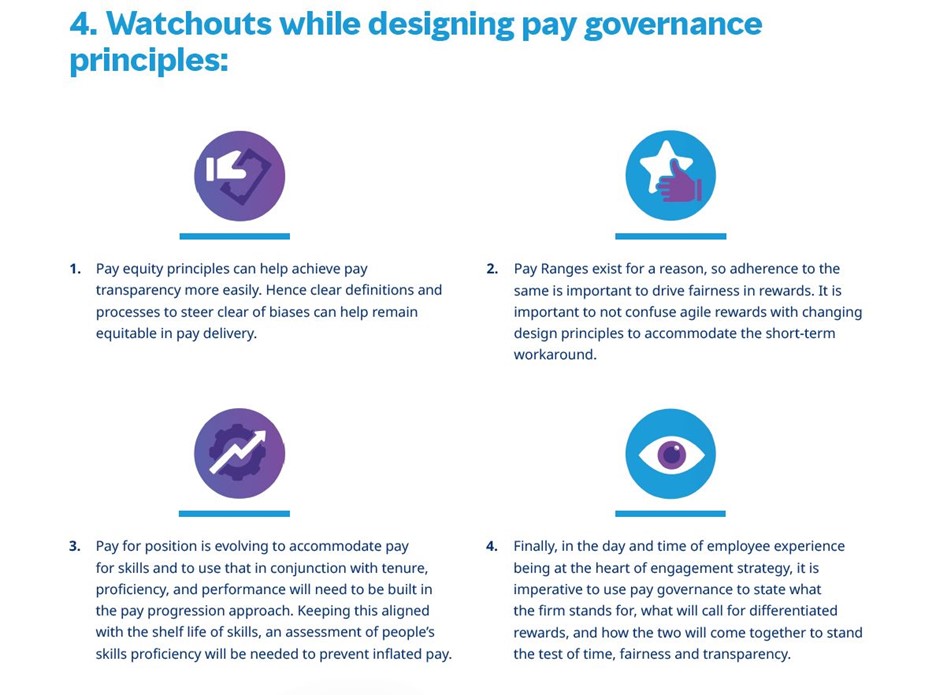
- Traversing the journey from pay transparency to pay equity (or the other way round depending on what the starting point is); Pay transparency could range from communicating individual employee’s placement within the grade and role-linked pay range right from a new hire to a tenured employee. It seems difficult to achieve this due to an inequitable placement of employees, sometimes due to labor shortage but also due to bias impacting pay decisions. So, being transparent about ranges is a more achievable goal once pay equity principles have been at play. Pay equity means, given similar roles, levels, performance levels, and pedigree/ tenure (this may be important in different kinds of organizational construct), pay is equitable/similar, ruling out the presence of an unconscious bias. Mercer’s global study, “When Women Thrive” indicates, equity in pay can only be achieved through equity in opportunities for the roles that matter, closer to creating organizational value and impact. One key metric for pay governance towards the ESG journey could be very simple pay transparency adoption by the firm. This means building principles to manage equity of pay and then adopting transparency in communication. If employees understand the reason for their placement within the defined range, which could be the tenure in the role, impact of performance, difference in the pedigree, or the skill set brought into the role, the governance goal is met! There are a few organizations that have achieved pay transparency by communicating the pay range to the new hire and their fitment with logic, sharing with managers and the placement of their people as well as quartile positioning of the employees with the reason as well as what entails progression within the ranges. The governance for managing pay equity through internal pay ranges is explored in the subsequent point.
- Pay governance around managing through the sanctity of internal pay ranges amidst “hiring pressures and talent war”; The regular shift of power between an employee and employer results in managing rewards as an exception. During a tough macroeconomic environment, businesses find it tough to sustain and grow. As employers sometimes retain employees at the cost of taking a hit at their margins, the power shifts towards the employers as the employees may not have too many choices available. This could result in pay decisions around marginal pay increases, less than “on target” bonus payouts, and a more differentiated pay strategy to only ring-fence key talent. However, when it is an employees’ market, there could be too many opportunities at the back of tailwinds resulting in churn of employees, and employers are forced to be more generous with their pay choices. Typically pay range is the typical min-max price range of the job broken down into quartiles for placement of all the employees doing that job based on their performance and tenure in the role. In the event of hiring pressure due to a war for talent, the principles of placing the people in the first quartile if a new entrant into the role internally or externally or moving a high performer or a high-tenured employee in the second or the third quartile, may be bypassed. Given this, the existing workforce may feel shortchanged with an inconsistent experience with their pay. This shifting of power and the resultant impact on pay ranges can perhaps be balanced by adopting a more agile talent management system where the internal workforce can also apply to the upcoming jobs in high demand, thereby commanding a significant shift in pay. Additionally, bringing in a flexible workforce for some time to manage peaks of talent demand may also be useful to prevent fixed pay inflation. While this approach of using flex and flow models of talent helps prevent pressure on the ranges, it requires constant monitoring and a more consistent business-led talent approach to make it effective.
- Pay progression principles Mercer’s 3P framework helps place importance on each of the factors of role, performance and skill, tenure, and pedigree (as person-based factors). With the ever-evolving landscape today, the need for fixed-based pay is changing to perhaps consider a cluster of skills required to perform those jobs. This in turn requires defining skill clusters as vanilla, advanced, niche, and super niche and deciding the premium attached to each. As people will move from one to a different cluster the premium therefore, the shelf life for which this may be applicable, how higher tenure in a role may lead to higher proficiency in tur higher performance level, and the pay differential for that. Equally important will be individual factors like specific pedigree baselining skill availability (like PhD for specific R&D jobs aerospace engineering for MRO jobs or data analytics skills for data scientist jobs etc. As we establish pay progression principles, it will be important to establish how this progression may look across different career levels and measure them in the form of metrics. Pay consciousness around the ratio of average employee to CEO pay and ensuring there isn’t disproportionate wealth amassed at the cost of an average employee is also a core governance principle. This can be achieved by using a pay mix and using it appropriately at each level, with higher / progressive pay at risk to the tune of 60-70% of total pay at senior levels to remain variable in line with short and long-term performance goals. While the pay mix is more aligned to fixed pay at the entry to mid-career levels.
Mansee Singhal
India Career Leader, Leading Rewards and Talent Advisory
Mercer
India Career Leader, Leading Rewards and Talent Advisory
Mercer
Related products for purchase
Related Solutions
Related Insights
Related Case Studies
Curated