Talent solutions for the Energy and Natural Resources (ENR) Sectors in the Middle East.
Mercer Middle East is your partner
for your most important asset – people.
Optimize talent to capture growth
Amid global turbulence, pockets of opportunities emerge – for those willing to adapt.
In the Middle East, continued investment activity and stable economic fundamentals support a comparatively positive outlook, particularly as energy transition timelines extend beyond initial projections. Indeed, the regional conditions could present growth opportunities for the energy and natural resources sectors.
Optimizing your talent is central to capturing that growth; our recent survey of regional leaders highlights some clear levers:
- Talent skills development: Upskill and reskill your workforce with deeper commercial acumen, new tech competency, and AI fluency. Workforce planning can then become capabilities driven.
- Embracing technology: Maximize workforce productivity and efficiency thorough automation and AI utilization.
- Enhance HR business model: Streamline HR along transactional and strategic functions; automate the transactional where possible and close the “perceived strategic value” gap at the senior manager level.
ENR sector-specific solutions
An engaged workforce with the right skills holds the key to growth in the energy and natural resources sectors.
Transformation in a few key areas will enable enterprises to capture latent opportunities: Talent & Skills, Technology & Workforce Transformation, Strategic Workforce Planning (SWP), Wellbeing & Health, and Rewards.





.png)
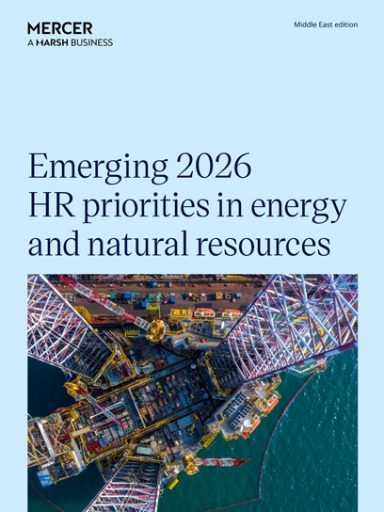
Emerging 2026 HR priorities in energy and natural resources
Featured Insights
A future-ready workforce isn't built by predicting the future, it's built on a workforce embracing continuous acquisition of skills and learning. HR's strategic role is therefore to map how capability agility, and talent resilience can be woven into the enterprise DNA.
-Milan Taylor
Partner & Global Energy Leader, Mercer
ENR Middle East Team
Mercer’s Energy and Natural Resources practice brings a deep understanding of the industries’ unique workforce needs.
The team across the MENA region is led by Andrew El Zein. Andrew brings extensive expertise from both enterprise and consulting perspectives and he oversees strategic initiatives and key client relationships in the sector.
Through global collaboration and deep client partnerships, Andrew and the team are helping to shape energy and natural resources organizations in the Middle East – by helping them attract, develop, and retain top talent.
Service areas to the energy and natural resources sectors:
-
HR operating model and function redesign
-
Work design
-
Skills-powered organizational development
-
Strategic workforce design
-
Organizational design
-
Data-driven rewards
FAQ
The Energy and Natural Resources sectors in the Middle East can enhance productivity and drive growth by adopting tailored talent and workforce solutions.
Based on Mercer’s global research and experience partnering with senior HR leaders, the most effective talent solutions combine:
- Skills-Based Job Architecture: Moving beyond traditional role-based recruitment to capabilities-driven workforce planning. Mercer research shows that organizations further ahead on becoming skills-powered organizations report stronger business outcomes and employee engagement.
- Strategic Rewards: As competition for national and expatriate talent continues across the Middle East, Energy and Natural Resources employers should first understand how their rewards compare with those of competitors – both within their sectors as well as the broader market. Employers are then encouraged to build employee-centric rewards that maximize retention and engagement.
- Technology & Workforce Transformation: As digital transformation brings fundamental changes across all industries, HR departments in the Energy and Natural Resources sectors must harness technology to improve efficiency, reduce costs, and enable strategic workforce planning. For organizations that have already invested in new technology systems and platforms, maximizing the return on these investments is a key focus.
- Well-being & Health focus: The health and well-being of your workforce is critical to the success of the business. Moreover, when employees have access to a wide range of benefits – appropriate to their needs – they tend to be healthier, more productive, and more engaged.
- Employee Listening and Engagement: A thriving workforce can be created when employers meet their workforce’s needs. Employees know what matters to them and are increasingly vocal about it. It’s incumbent upon employers to listen and respond. Combine robust listening tools with Mercer’s extensive normative database, adaptive approach and deep expertise across HR, reward and transformation to evolve your employee’s experience.
- Employee assessments: To make predictive workforce decisions with confidence, you need talent assessment, leadership, and capability development solutions. The entire employee lifecycle is presented by combining behavioral science, technology and data insight.
Mercer integrates assessment solutions seamlessly into the flow of work, ensuring they align with your Energy and Natural Resources organization’s employer brand. We help accelerate your most critical talent goals and priorities – ones that directly impact your evolving business imperatives. - Employee Value Proposition (EVP): Employees’ core expectations about work are changing. Many are now searching for a caring corporate culture that prioritizes their mental and physical health while providing work-life balance and career paths – sustainably.
Employees seek more than just financial rewards or external motivation. To attract and retain talent, your EVP must adapt to align with the evolving values and priorities of your Energy and Natural Resources workforce.
Based on Mercer’s recent research with senior HR leaders across the region, the following priorities are firmly on the HR agenda for the Energy and Natural Resources industries:
Skills Development: Upskilling and Reskilling
Skills, both upskilling and reskilling, emerge as the key talent priority for 2026. This need is urgent when viewed through the lens of AI and recent technology advancements. Across the workforce, employees are increasingly expected to use digital tools that automate tasks and integrate systems, which requires fundamental capability building. HR teams are themselves expected to utilize new skills. Overall, organizations must shift from tenure-based to capability-based progression models.
Leadership needs to drive skills development by communicating their vision for becoming a skills-powered organization, including explaining how AI will impact jobs and plans for upskilling.
Talent Retention and Career Development
Competition for talent continues across the Middle East, with Energy and Natural Resources companies competing against government Vision programs (UAE 2031, Saudi 2030, Qatar 2030) and other sectors. To remain competitive, organizations must provide clear career pathways, mentorship opportunities, as well as programs and incentives for upskilling and reskilling enhancement.
AI Integration and Digital Transformation
Adopting new technologies is vital in a competitive market. Organizations need to embrace new technologies to improve productivity and efficiency.
Work-Life Balance and Employee Experience (EX)
The scope of the EX has grown in recent years. It’s no longer just about employee engagement but about helping people thrive in all aspects of their lives, including work. Business leaders and HR teams need to create an environment where employees can thrive, be productive and engaged while delivering business results. One of HR’s focuses is enhancing EX and the employee value proposition (EVP).
Technology is fundamentally transforming productivity across the Energy and Natural Resources sectors as well as playing a vital role in assisting the Middle East through the energy transition process. Multiple strategic channels are in play:
AI and Intelligent Automation
AI-driven predictive maintenance, automated drilling, and safety monitoring augment operational efficiency. Advanced algorithms analyse real-time grid conditions, forecast demand, and balance renewable inputs to maintain stability.
Data-Driven Decision Making
Real-time monitoring enables predictive decision-making across operations, finance, procurement, HR, and communications functions. Enhanced energy trading leverages machine learning to simulate market conditions and optimize trading strategies.
Workforce Optimization Through Technology
Organizations can do more with less. Cross-training, leadership development, and advanced planning together build a more agile workforce. Rather than simply expanding headcount, companies leverage the full-time workforce, AI agents, project-based teams, and contractors to drive sustainable efficiency. This allows employees to take on multifaceted skill-based roles without proportional increases in staffing levels. In turn, skills-based roles increase variety and employee engagement.
The future Energy and Natural Resources workforces require a sophisticated blend of technical expertise, commercial acumen, and adaptive capabilities:
Digital and Technical Competencies
AI fluency, data analytics, and automation tool proficiency across the entire business, including support functions.
Commercial and Strategic Expertise
As Energy and Natural Resources companies in the Middle East expand abroad and shift from being operators to asset managers or private entities, employees must develop advanced commercial skills to drive growth and deliver shareholder value.
Essential skills include commercial knowledge, deal structuring, market analysis, energy transition expertise, and stakeholder engagement. Additionally, effective risk management and strategic investment decision-making are vital for success in global markets.
Future-Ready Behavioral Skills
- Leadership, critical analysis, and strategic thinking – capabilities that many current frameworks neglect but are essential for navigating transformation.
- Adaptability and continuous learning mindset to stay relevant amid rapid change.
- Cross-functional collaboration capabilities to work effectively across traditional silo boundaries.
- The ability to work effectively with AI and advanced technology rather than being replaced by it – understanding how to leverage AI for productivity gains while maintaining human critical judgment and creativity.
Career Transparency and Mobility
Organizations must provide clear career pathways, mentorship programs, and incentives for skill enhancement to maintain a motivated workforce. This includes creating dual career ladders for leadership and technical mastery and implementing skills-based job structures that enable greater workforce mobility. Transparent communication about career opportunities and advancement criteria are also essential.
Purpose-Driven Work
Connecting employees to sustainability goals and energy transition missions helps to create meaningful engagement. Organizations must foster a culture of continuous learning and innovation, encouraging employees to take ownership of their professional development. Leadership plays a crucial role in communicating the vision for transformation and helping employees understand their unique contribution to larger organizational goals.
Investment in Development
Employees in the Middle East, including those in the Energy and Natural Resources Sectors, place increased premium on organizations that invest in their skills growth. Upskilling programs that prioritize meaningful employee engagement demonstrate organizational commitment to individual futures. This investment is particularly critical as AI reshapes roles and creates new opportunities for those prepared to adapt.
Recognition and Rewards
Structured recognition programs that are timely and personal, combined with performance-based compensation, and aligned with individual and organizational goals, drive engagement. Progressive organizations in the Middle East and globally, are moving toward segmented reward strategies that recognize different talent segments have different motivators.
Flexible Work Environment
Addressing work-life balance concerns through individual-driven flexible work arrangements and hybrid models is important. Focus on employee well-being and mental health support creates psychologically safe environments for feedback and innovation. Meaningful lifestyle working contracts become essential in tight labor markets.
Transparent Leadership Communication
Leadership must communicate the vision for becoming a skills-powered organization, including explaining how AI will impact jobs and plans for upskilling. Transparent communication about transformation initiatives, career opportunities, and organizational changes builds trust and employee engagement.
Organizations that successfully utilize talent solutions to navigate these priorities will not only survive the rapidly changing commercial and energy transition landscapes but thrive – positioning themselves as employers of choice in the Middle East.