Building a robust sustainable investment strategy
Why a sustainable investment strategy is critical

Investing sustainably – for the future – goes beyond just incorporating environmental, social and governance considerations. It also involves paying attention to diversity, equity and inclusion (DEI) within managers and strategies, and striking a balance between doing the right thing and delivering on investment commitments, which is otherwise known as impact-investing.
Our sustainable investment declaration outlines our approach and commitment to helping you make a positive sustainable impact while aiming to generate favorable returns.
Questions to ask when defining your approach:
- Where am I on my sustainability journey?
- Where are asset managers on their journey?
- What practical changes can I make today?
- How can I ensure that DEI is a priority for managers and in strategies?
- How do I strike an optimal balance between the greater good and meeting my financial objectives?
Considerations when building your sustainable investment strategy
There are many ways to approach ESG within a portfolio. The following are the main strategies, which can be implemented individually or in combination. We believe success requires a mixture of these elements:
ESG strategies
- Integration: Include ESG factors in investment decisions.
- Investment: Allocate budgets to sustainability themes or impact investments for new opportunities.
- Stewardship: Take part in voting and engage with underlying companies and policy makers.
- Screening: Eliminate sectors and companies deemed irresponsible and not aligned with your values.
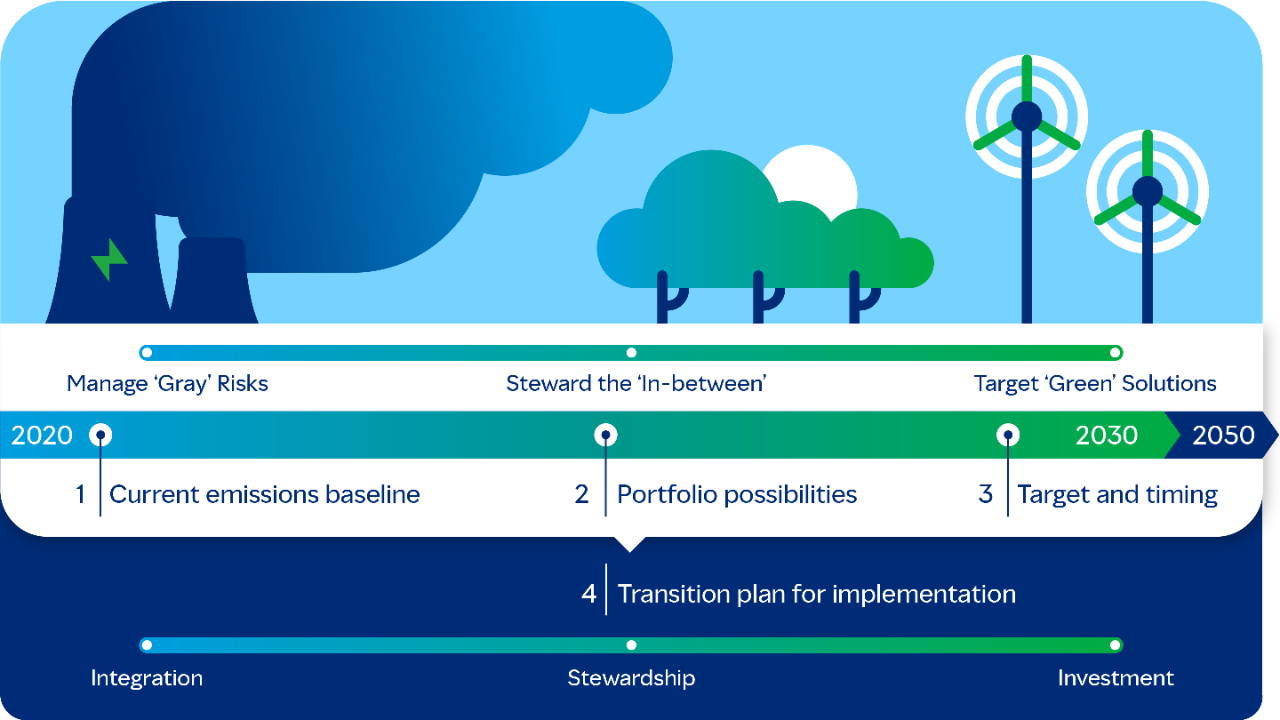
Climate change is a pressing issue for the planet and for the investment community. Institutional investors, such as pension funds, financial institutions, insurers, wealth managers, endowments and foundations, hold trillions of dollars in assets in their portfolios. In a decarbonizing economy, these assets are highly exposed to climate transition risks.
Climate change scenario modelling
Our global partnership with Ortec Finance has enabled us to provide all types of institutional investors with a rigorous analysis of the climate crisis. Our scenario modeling uncovers emerging opportunities, helping investors decide how they want to influence the climate crisis and how to make their portfolios resilient against future challenges.
Our quantitative analysis, in line with the Task Force on Climate-related Financial Disclosures (TCFD), is grounded in economics and science. This analysis provides a deep level of granularity, allowing clients to consider whether climate impacts are fully priced into every asset class and economic sector before reallocation decisions are made. The long-term projections it provides are integrated into Mercer’s capital markets assumptions across all our services.
As part of a wider strategy to invest sustainably, integrating a DEI lens into your decision-making process allows you to align your portfolios with your organizational mission and values. It also positions you to achieve long-term sustainable returns and will help drive change that could ultimately benefit us all.
Three steps to integrate DEI into your investment portfolio
- Define what diversity means to you
- Build a process and a strategy
- Implement your plan
No matter where you are on your DEI investment journey, we can help you define what diversity means for your organization and integrate it within your portfolio and investment decision-making process.
There are a number of approaches to sustainable investment, including ESG integration and screening, thematic investing and impact investing. More investors are looking to impact investing to help them strike a balance between doing the right thing for the planet, while pursing financial returns. There are a number of considerations for impact investing.
Considerations for impact investing
- Defining your ambition and project themes
- Identifying opportunities to strike a balance
- Sourcing and accessing managers
- Reporting on progress and impact
Our team of experienced specialists can help you review your objectives against your investment goals, defining an optimal strategy that balances your sustainable investment ambitions with returns.
Tools to help you amplify your sustainable investment strategy
Climate Benchmark tool
Transition framework for emissions reduction
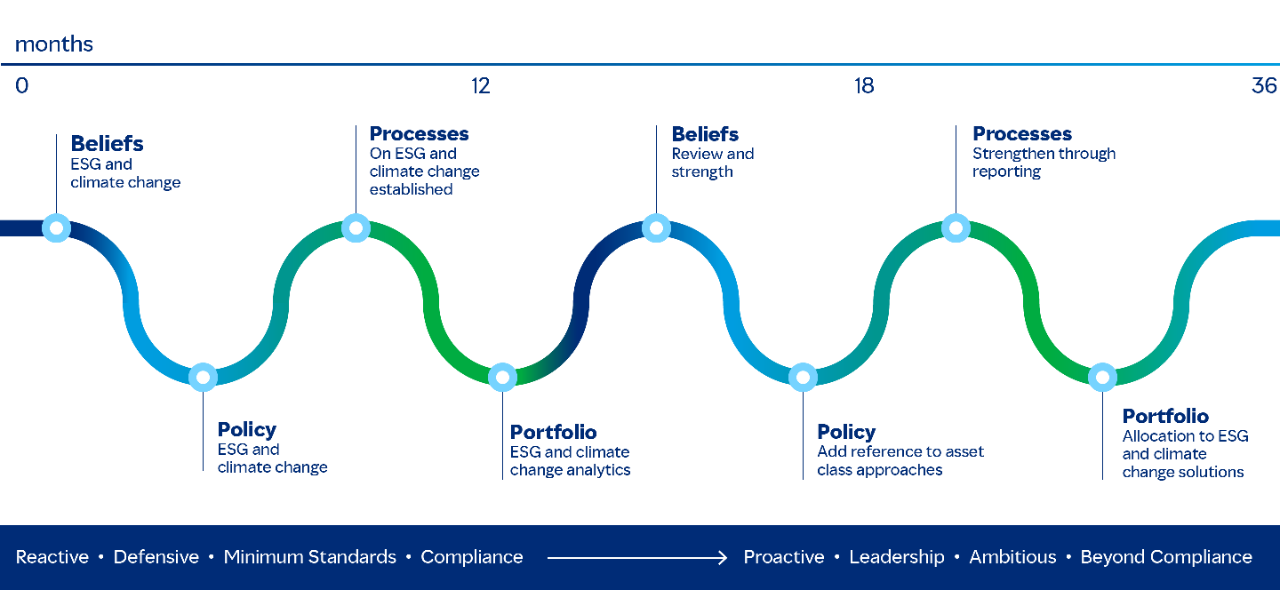
Sustainable Investment Pathway

Our commitment to help make a difference
Pursuing net-zero by 2050
We have identified clear goals and accountability
- We expect to reduce portfolio carbon emissions by 45% from 2019 baseline levels.
- By 2050, we have committed to hit net-zero carbon emissions for our UK, European, Australian, New Zealand and Asian clients with discretionary portfolios and for most of our multi-asset funds domiciled in Ireland.
- We will produce annual progress reports on emissions, alongside carbon intensity reports.
Sustainable investment solutions for institutional investors
-
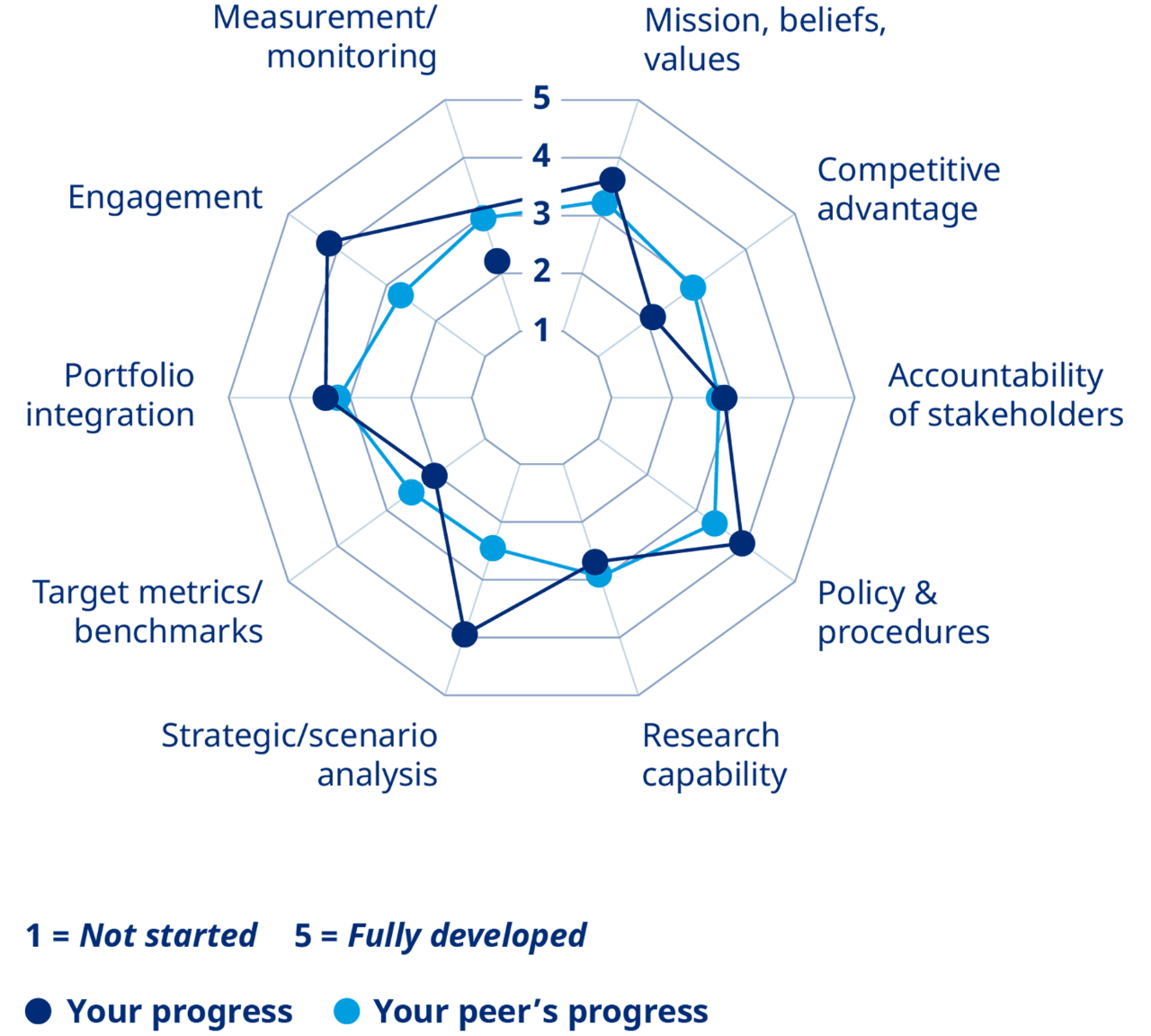
Responsible Investment Total Evaluation (RITE)
This tool provides an evaluation across your beliefs, policies, processes and portfolio. It shows you how you’re doing on a scale from A++ to C and compares you to your peers. It can also monitor your improvement over time. -
Sustainable investment pathway
This advice and implementation framework provides you with the foundation for strong governance and portfolio implementation, helping you take action on your sustainable investment journey. -
Analytics for Climate Transition (ACT)
This framework assesses a vast range of data to rank the transition capacity of listed companies to help you position your portfolios for a carbon-free future. -
Investing for impact
We can help you build a robust impact investing strategy designed to accelerate real-change and whilst helping you pursue stronger returns for your portfolios. -
Integrating DEI
We can help you define and build a diversity, equity and inclusion (DEI) investment strategy that seeks to deliver positive change and stronger portfolio outcomes. -
Investment research
Access the latest strategic investment research on MercerInsight Community and our forward-looking asset manager research on MercerInsight to help guide your investment decisions.
It's all here: MercerInsight® Community
Introducing some of our team
Leverage our breadth and depth
Awards
Investment consultant of the year 2023
Mercer has been recognized as the investment consultant of the year by Environmental Finance for pioneering sustainable investment and assisting more than 25 institutional investors around the globe to better assess their exposures to climate transition risks.
Wherever you are on your sustainable investment journey, we can help.
Before you access this page, please read and accept the terms and legal notices below.
You’re about to enter a website intended for sophisticated, institutional investors and the information contained herein is not intended for investors who are not qualified purchasers as defined in the US Investment Company Act of 1940. Information about Mercer strategies is provided for informational purposes only and does not constitute, and should not be construed as, an offer to sell, or a solicitation of an offer to buy, any securities, or an offer, invitation or solicitation of any specific products or the investment management services of Mercer, or an offer or invitation to enter into any portfolio management mandate with Mercer.
Mercer makes no representation, and it should not be assumed, that past investment performance is an indication of future results. Moreover, wherever there is the potential for profit there is also the possibility of loss. Any person unable to accept these terms and conditions should not proceed any further. Mercer reserves the right to suspend or withdraw access to any page(s) included on this website without notice at any time and accepts no liability if, for any reason, these pages are unavailable at any time or for any period.