How becoming skills-powered unlocks new talent pools in an aging workforce

 1340723070
In Asia’s fast-changing, aging economies, fixed job descriptions and rigid roles can’t keep pace. To stay competitive, organizations must harness all talent segments through flexible, skills-powered strategies.
Asia is undergoing a rapid demographic transformation, with Japan having the world's oldest population—over 29% aged 65 or older. South Korea and Singapore are aging even faster, while China faces a "demographic cliff" due to decades of low birth rates. This shift presents critical workforce challenges:
- By 2030, Japan will face a shortage of 6.44 million workers.
- South Korea's working-age population is projected to shrink by 35% by 2050.
- Singapore expects 32% of its citizens to be aged over 65 by 2060.
- China's working-age population is declining by over 3 million people annually.
Organizations must rethink their approach to work, as there aren’t enough younger workers to replace those who are retiring.
Companies will need to adopt a more flexible, skills-focused approach to fully leverage the available talent pool.
What is a skills-powered approach?
A skills-powered approach organizes work around individuals' skills rather than traditional job roles. Instead of defining jobs first and finding individuals skills to fit those molds, this model starts by assessing individual capabilities and dynamically matching with the tasks and projects that needs to be accomplished.
A skills-powered approach allows for much greater flexibility in how work gets executed rather than being limited by rigid job descriptions. This allows organizations to deploy talent through a variety of arrangements, including:
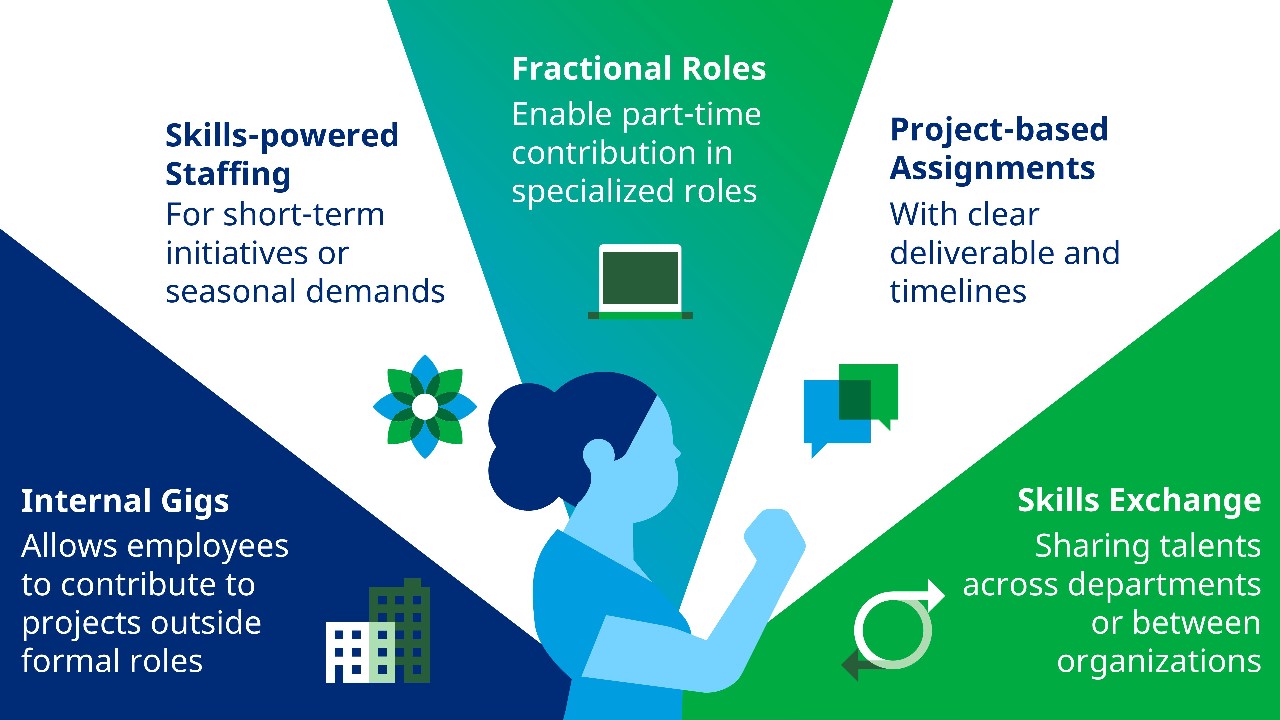
The image represents a visual representation of various modern workforce strategies leveraging skills. It highlights five key concepts:
- Skills-powered staffing - focused on short-term initiatives or seasonal demands
- Fractional roles - allowing part-time contributions in specialized roles
- Project-based Assignments - Defined by clear deliverables and timelines
- Internal Gigs - Enabling employees to engage in projects outside their formal roles
- Skills Exchange - Facilitating the sharing of talents across departments or between organizations
How does a skills-powered approach benefit your organization?
Considering Asia’s demographic reality, becoming skills-powered is not merely an HR innovation, but an economic and business imperative. Here are three benefits of a skills-powered approach:
1. Extended productive careers: By focusing on capabilities over age or tenure, companies can create flexible pathways for experienced workers to contribute their valuable skills beyond the traditional retirement age.
2. Knowledge preservation: Skills-powered approaches enable more effective knowledge transfer between generations, ensuring critical institutional expertise is not lost with retirement.
3. Expanded talent access: By establishing more flexible work arrangements based on skills rather than job requirements, companies can tap into previously underutilized segments.
In the video below, we outline a four-step process to adopt a skills-powered approach in your workforce.
-
Case Study: How a skilled workforce can unleash productivity and retain talent
At Unilever, their skills-powered talent deployment has led to over 700 projects being resourced in just 90 days, with 60% of projects resourced cross-functionally and cross-geographically. A whopping 530,000 hours have been unlocked by this flexible approach – equivalent to 241 full-time employees. Additionally, 90% of employees learned something new and stated that they would do it again.
Standard Chartered implemented a reskilling and redeployment program across its Asian offices with Mercer’s support. Instead of resorting to layoffs or external hires, the bank retrained employees away from declining ‘sunset jobs’ and into high-demand ‘sunrise roles.’ This program not only preserved jobs but also saved an estimated $49,000 per employee in reduced recruitment costs and increased retention.[2]
How does a skills-powered approach access untapped talent pools?
As Asia’s demographic pressures intensify, a skills-powered approach supported by technological advancement can help unlock critical talent pools that traditional job-based models often overlook or underutilize:
Over 80% of workers over 50 in Japan wish to continue working[3] but prefer reduced hours or project-based roles — a trend echoed in Singapore and beyond.[4]
With older talent key to economic growth, tapping their skills could unlock US$5 trillion globally. Yet, age bias often prevents them from getting jobs. Focusing on skills rather than age or traditional career stages enables companies to tap into older workers’ capabilities through flexible arrangements that would otherwise be lost to retirement.
Female labor force participation lags behind men’s — 56% vs 72% in Japan, 58% vs 75% in South Korea, and 33% vs 82% in India — largely due to caregiving responsibilities.[5] [6]
In Japan matching female labor participation with that of males could add 7-9 million workers, offsetting losses from aging. Focusing on skills and results over traditional work arrangements can unlock this vital talent pool.
By creating flexible pathways for these and other underutilized talent segments, skills-powered organizations not only expand their talent pipelines but also directly address the demographic challenges reshaping Asian economies.
How to overcome the challenges of a skills-powered approach
While the benefits of becoming skills-powered are compelling, navigating region-specific challenges in Asian markets is essential for success:
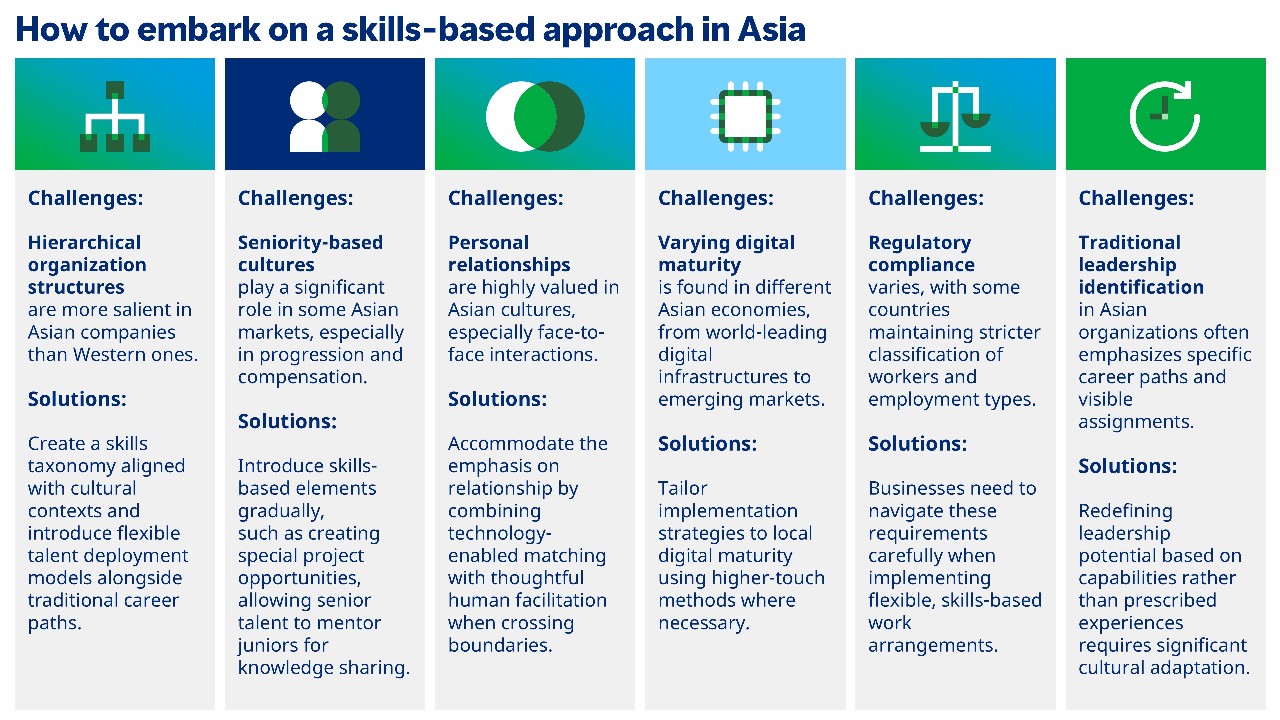
The image outlines a framework for implementing a skills-powered approach in Asian organizations. It is divided into six sections:
- Hierarchical Organization Structures
- Seniority-based Cultures
- Personal Relationships
- Varying Digital Maturity
- Regulatory Compliance
- Traditional Leadership Identification