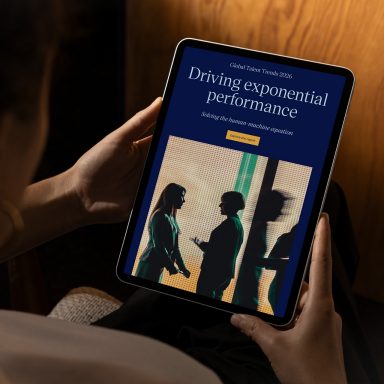
Why exponential performance is now a leadership survival test


In 2026, performance expectations have been fundamentally reset, and many organizations are not ready.
Yet the human system underpinning performance is weakening, not strengthening. Employee thriving has fallen from 66% in 2024 to just 44% in 2026—the lowest level since Mercer began tracking it. A depleted workforce cannot deliver exponential results, no matter how advanced the technology stack.
The problem is not a lack of ambition or technology. It’s that most organizations are still trying to deliver tomorrow’s performance using yesterday’s work models. This is why exponential performance is no longer an aspiration but the minimum viable response to volatility, AI acceleration, and rising people risk. And it’s why Global Talent Trends 2026 frames this moment so starkly: organizations must now solve the human–machine equation—how work is deliberately redesigned so human judgment and machine intelligence combine to create value at scale—or risk structural decline.
Three forces are colliding
-
Productivity pressure is intensifyingMore than half (54%) of C-suite executives cite talent scarcity as the top macro force shaping their people plans, even as expectations for growth and efficiency continue to rise.
-
AI expectations are accelerating faster than operating models can adaptLeaders and investors increasingly agree that redesigning work to incorporate AI and automation will drive the greatest return, yet far fewer believe their organizations are ready to execute on that ambition.
-
Workforce depletion and skills fragmentation are constraining executionSkills shortages, AI anxiety, and uneven access to tools are eroding confidence and resilience, undermining the very productivity leaders are trying to unlock.
The hidden constraint: how work really gets done
Most organizations are layering AI onto work systems that were never designed to absorb it: rigid roles, static job architectures, and decision rights optimized for stability rather than speed.
This helps explain a critical disconnect in the data.
of C-suite leaders believe redesigning work around AI will drive the greatest ROI
believe their workforce can effectively combine human and machine capabilities today
Technology does not create performance on its own. Performance emerges from the interaction of people, skills, workflows, incentives, and risk.
In the future of work, value is unlocked not by replacing humans but by intentionally redesigning work so machine intelligence amplifies human judgment, creativity, and scale. Human–machine collaboration is now the performance frontier, and avoiding work redesign is a risk decision. If AI is layered onto unchanged roles, decision rights, and incentives, organizations may achieve faster activity but not better outcomes.
When people risk becomes business risk
This shift fundamentally changes the leadership agenda. The Global Talent Trends 2026 data reveals a widening gap between ambition and readiness. While C-suite executives are prioritizing AI-enabled productivity and work redesign, many HR functions remain focused on optimizing existing processes rather than reshaping the work system itself.
At the same time, employees are increasingly anxious about AI. Some 36% say they would consider leaving their organization if they felt disadvantaged by unequal access to AI tools or training. A workforce that does not trust the transformation cannot sustain it.
In this environment, people risk has become enterprise risk. Talent, skills, trust, and adaptability now directly shape business outcomes—impacting execution speed, resilience, and investor confidence.
This is where HR’s role fundamentally changes—from steward of programs to architect of the work system itself, embedded in the decisions that shape performance and accountable for enabling human–machine capability at scale.
From experimentation to intentional, scaled transformation
The organizations that will outperform in 2026 are not experimenting more but are redesigning with intent. They are moving from technology-first thinking to work-first transformation. They are treating AI as an amplifier of human capability and not a substitute for it. And they recognize that scalable transformation depends on scalable human capability.
Together, these shifts outline a clear path from experimentation to intentional, scaled transformation—one where people risk is recognized as business risk and where the human advantage becomes the decisive source of workforce resilience and sustained performance.
This is how incremental gains become exponential.
What HR and leaders must do now
Exponential performance will not emerge by accident. It requires leaders—particularly HR and enterprise leaders—to redesign work systems, reframe talent strategies around skills, and build cultures of AI enablement grounded in trust, transparency, and equity.
The question facing organizations in 2026 is whether leaders will deliberately architect human–machine collaboration for sustained business value or continue digitizing work models that no longer work.
As organizations plan major operating and workforce redesigns in 2026, the Global Talent Trends report explores how organizations are making this shift, helping leaders assess where work redesign will deliver the greatest performance returns, and where people risk is already constraining growth.
In a year where incremental gains are no longer enough, the ability to deliberately orchestrate human–machine collaboration will define which organizations move ahead.