Talent management and mobility
Management’s perspective: talent mobility should support the business
HR needs to step back and consider the business purpose behind the mobility of talent. Individual moves might serve specific requirements and solve ad hoc business issues but talent mobility in general serves a broader purpose. Integrated talent mobility is about:
- Rightsizing and diversifying the international talent pool: efficient mobility talent management goes hand in hand with decisions about international workforce resizing, reshaping and reskilling. It is as much about managing an international talent pool as about moving people from country to country.
- Fostering talent diversity. If gaining international experience is the best way to reach the most senior management positions, the underrepresentation of women and minorities in the expatriate workforce is undermining attempts to improve diversity.
- Ensuring the right leadership talent pipeline is in place.
- Addressing key skill shortages in critical markets.
- Protecting key talents, by deploying them tactically from stagnant markets to more active ones.
- And more generally, enabling the continued globalization of functions and business activities.
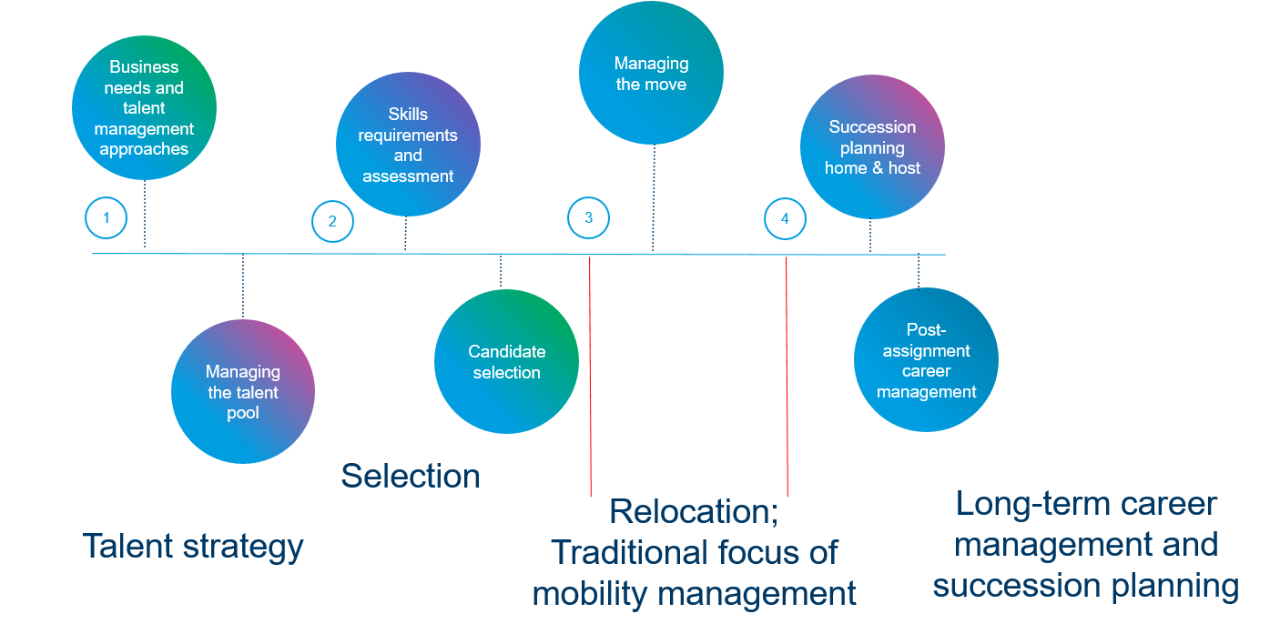
Integrating talent management and mobility is possible only if the entire talent cycle is taken into consideration. The limited purview of many HR and mobility teams tend to curb integration opportunities.
What’s the company’s talent strategy? Build, buy or borrow?
| Build | Buy | Borrow |
|---|---|---|
| International assignments; developmental moves | International foreign hires | International assignments; moves to address ad hoc issues |
| Virtual training assignments | Locally hired foreigners | Gig workers / freelancers |
| Lateral moves between functions | Company acquisition | Talent exchange internally or externally with peer organizations |
| Automation / enhancing employees | Automation / replacing employees | Outsourcing |
The employee’s perspective: mobility to accelerate careers
HR needs to assess how mobility is fostering (or indeed hindering) career progress and identify which moves are driving the most value for employees. Mobility should help employees access:
- The right job: Not all positions are equal when it comes to boosting employees’ careers. The types of positions that are real career accelerators depend on the company and industry sector. Global mobility plays a role by allowing high-potential employees to access these jobs globally.
- The right skills: The required skillset varies from company to company but is likely to be a mix of technical and managerial competencies (international management) as well as soft skills, including intercultural skills and people management skills. In terms of knowledge, understanding current or future key markets for the company and staying up to speed with new trends are career accelerators.
- The right network: A corporate career is at best about teamwork and at worst a political game. Proximity to top management, the opportunity to exchange and learn from the company’s top experts and more generally the ability to network with those who can be qualified as the “top influencers” within the company is a differentiator. The location of employees (at HQ, in a major regional hub or on the contrary in a small, remote operation) influences their ability to build an efficient network.
Building hybrid talent: the role of mobility
Digitalization and the replacement of rigid job definitions by more fluid skills-based approaches is prompting companies to look for new talent profiles and more specifically for “hybrid profiles.”
The characteristic of a hybrid profile is that it combines the skills and knowledge of different lines of business or functions. It could be, for example, business managers with advanced tech skills and who can work closely with the IT department as well as those finance and HR managers that rely on analytics to provide strategic input, or HR team members who can use marketing techniques to boost employer branding.
Mobility has a role to play to help develop these forms of hybrid talent. High-profile employees will be required to upskill or reskill and match future work requirements through international developmental moves as well as lateral moves between functions.
Combining geographic and lateral mobility
From a career-management perspective, lateral moves are about moving between types of jobs or functions as opposed to being promoted within the same job family (vertical moves).
Lateral moves are important because they can ease the pressure on the company to provide promotion opportunities by increasing the number of possible job options for employees — and potentially for returning assignees. In the context of a fast-moving workplace and digitization, they are a way to develop new skills and maintain employability.
The future of work is likely to be about changing jobs (and even career paths) frequently as opposed to having a more traditional linear career progression. But this kind of flexible career path can work only if there is a greater degree of recognition and acceptance of lateral moves by both employees and management.
Rethinking selection: who should move?
Positive reasons for selection
Open and rigorous assessment process / Searching the wider talent pool
Relevant experience and skills
Being part of talent development program
Proactive support for gender parity and minority integration / Fact-checking success factors
Questionable reasons for selection
Having the right contacts internally (at worst: office politics) / Limited talent search pool
Past performance that is not relevant to the assignment
Expediency: the candidate needed a job and nothing else was available / Absence of long-term goals
Background: e.g. having attended the right school / Biases: assumptions about profiles likely to succeed