What’s really needed for lasting transformation?


Agility is no longer a project management philosophy; it’s the lifeblood of the modern organisation.
Agile began in software development. Teams would iterate new products incrementally, based on quick-fire customer feedback and roll out updated versions in a cycle of testing and learning.
From there, the core values of agile were often applied beyond the tech department, finding another home in organisational design and workforce management. The need to react and adapt more quickly in an increasingly complex and challenging landscape ushered in numerous agile-inspired management philosophies including, but not limited to: Holacracy, flat management, sociocracy and teal organisations.
3 core values of agile:[1]
Prioritise individuals and interactions over processes and tools
Prioritise customer collaboration over contract negotiation
Prioritise responding to change over following a plan
For some businesses, agile is entering a new phase. As it has become an increasingly dominant term within organisational change, some organisations have found its implementation reduced to a narrow set of prescribed rituals and routines that risk becoming self-serving or disconnected from real business outcomes. Others are concerned that the hype surrounding agile (and the proliferation of endlessly reconfigured squads, tribes and pods) can leave employees struggling to maintain a sense of professional identity and sustained energy.
For businesses facing these challenges, language such as “adaptability” and “adaptive capacity” feel more aligned with their goals. This new emphasis goes beyond process and builds true organisational resilience by highlighting that navigating constant disruption and complexity hinges on the mindsets, behaviours and core skills of the workforce.
Are skills missing from the equation?
Improving workforce agility is among the top three business priorities for 2025.
Mercer’s 2025 Executive Outlook
Designing for agility
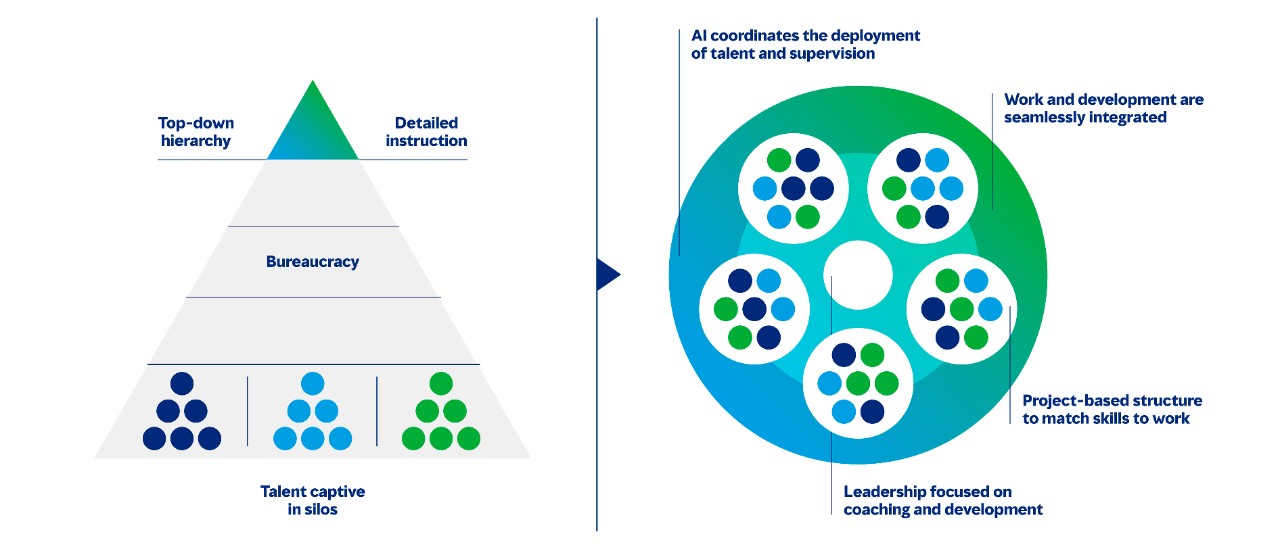
Left Section (Pyramid Diagram):
- The pyramid is segmented into three horizontal layers:
- Top layer: Labelled "Detailed instruction," representing the most specific and directive level.
- Middle layer: Labelled "Bureaucracy," indicating a more structured but less detailed level.
- Bottom layer: Labelled "Talent captive in silos," depicting isolated groups or units.
- The pyramid is topped with a small triangle labelled "Top-down hierarchy," emphasising a hierarchical approach at the top.
- At the base of the pyramid, there are three groups of circles, each group in a different shade of blue or green, representing different talent groups or silos.
Right Section (Circular Diagram):
- The circle contains five smaller circles arranged in a circular pattern, each filled with clusters of small circles in shades of blue and green.
- Surrounding the circle are four key points:
- "AI coordinates the deployment of talent and supervision" (top)
- "Work and development are seamlessly integrated" (right)
- "Project-based structure to match skills to work" (bottom right)
- "Leadership focused on coaching and development" (bottom left)
- The overall design suggests a shift from hierarchical, siloed talent management to a more integrated, agile, and AI-coordinated approach emphasising seamless work, project-based structures, and leadership development.
Benefits of agility backed by skills
Only 27% of executives believe their talent models are agile enough to pivot people from one area to another.
Mercer’s 2025 Executive Outlook
-
Greater speed in executionAgile teams often rely on “sprints”, where feedback is received on their work-in-progress for faster development. Agile’s built-in transparency, iterative planning and feedback loops give organisations a clear sense of critical skills and emerging gaps so they can be addressed in good time.
-
Improved productivity, sustainability and performanceAgile teams pride themselves on their adaptability and prioritisation, focusing on the highest-value tasks to maintain focus. Often, reduced bureaucracy via a culture of open feedback also drives efficiency.
-
Personalised, continuous learningAgile teams' test-and-learn mindset makes continuous learning a natural part of the workflow.
-
Continuous supply of relevant skillsAgile organisations refuse to lose momentum on upskilling and reskilling talent, meaning that business-critical skills are continuously cultivated.
-
Seamless talent/skill deploymentIn an agile model, teams are often cross-functional and talent mobility is king. Employees are directed towards the highest-impact projects or tasks based on their skillset and availability (e.g., in an internal talent marketplace), meaning talent and skills deployment are much more fluid.
What you need to begin your agile transformation
1. Foundational elements: Tasks, skills and AI
The underlying units of work grow in importance as the deconstruction, redeployment and reconstruction of work becomes a perpetual need
The currency of the workforce and the foundation for connecting talent to work
A work partner, insight generator and talent management tool (skills matching, human-machine teaming)
2. The right mindset, skillset and toolset
- 1 Mindset
- 2 Skillset
- 3 Toolset
- Cultural shift towards agility, collaboration and innovation
- Engaged leaders who foster internal mobility
- Empowered employees who take ownership of their development
- Understand the case for agile and desired outcomes
- Continuous learning and development baked into the work experience
- Organisation-wide capabilities in adaptability and agility
- Feedback as a universal skill to foster learning and agility
- Deconstruct jobs, redeploy tasks and reconstruct work with work design
- Address changing skills demand with continuous talent development
- Connect talent to work with seamless talent deployment
- Human-machine teaming (including agentic AI)
- Data-driven decision making across workforce management, talent acquisition and engagement
3. Agility enablers for lasting transformation
A solid skills foundation encompasses a comprehensive skills taxonomy that includes both technical and soft skills, along with skills validation through proficiency levels and assessments.
As in any skills-powered transformation, embracing agility means embracing progress over perfection.
Ready to dismantle what’s no longer fit for purpose? Discover more about embracing agility with Mercer:
Senior Partner, Global Transformation Services Leader
Workforce Transformation, UK & Europe
Partner, Workforce Transformation, Australia
Work & Skills Solutions Leader
Transformation Lead, International