OCIO: ‘To lift out, or not to lift out’


Each asset owner has their own individual objectives, circumstances and challenges they need to overcome.
Many asset owners, if not all, are continually focused on how to simplify, reduce risk and drive cost efficiencies across their organizations.
Being able to balance investor risks and returns with reputational and wider organizational requirements is an ongoing challenge for decision makers, made even more difficult by the increasing market complexity and heightened uncertainty investors face in the current macro environment.
Asset owners are increasingly aware of the risks that non-financial factors such as governance pose to overall portfolio performance. But sometimes pressure can come from sources that are difficult to control. According to our Large Asset Owner Barometer 20251, two of the most common drivers are resource constraints and difficulty accessing investment talent.
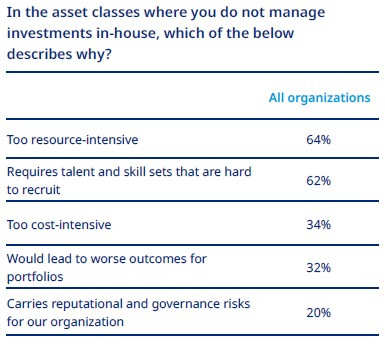
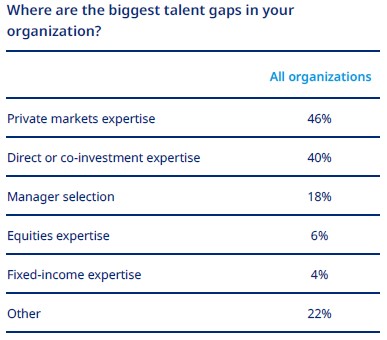
Being unable to access the right expertise and resources impedes their ability to effectively conduct manager research and selection, access specialist areas such as private markets, and implement specialist strategies such as sustainability and impact investment.
As a result, more and more asset owners are looking externally for support on a variety of needs, from strategic portfolio management advice, asset allocation and direct investing capabilities, to access to manager research and support with day-to-day operations, with only one in 20 (5%) of asset owners reporting to managing all their investments in-house.
Three steps for optimizing your investment process
Your investment strategy and oversight processes should support your investment goals. There are three stages to consider as part of this review.
1. Review and adapt your governance framework
It is vital to keep your portfolio on track. If you need to improve your governance operating model, our investment solutions can provide the support you require, both now and in the future.
2. Assess your portfolio against your future objectives
Understanding how investments are performing takes vigilance. Investors must also search for new opportunities in order to future-proof their portfolios.
3. Test your ability to adapt and respond to market movements
You need to be in a position to rebalance your portfolio quickly and effectively if you are faced with market volatility. We can help you install optimized decision-making processes. These will ensure your portfolio is responsive and aligned to your outcome requirements.
Common myths about investment solutions and OCIO




Key considerations for asset owners
- 1 Manage risk
- 2 Embed sustainability
- 3 Identify new opportunities
Ensuring a successful ‘Lift out’ requires selecting the right partner
Cost reduction is often a key objective and success criterion for a lift-out transaction. Ensuring the selected OCIO provider can help achieve this goal, with no constraining limitations on scope or service, should therefore not be overlooked.
Partnering with an OCIO provider can also support access to a wider range of investment expertise and solutions. This is particularly true in more specialist areas such as private markets and sustainable investment. Along with the increased flexibility of open architecture, the economies of scale that the largest OCIO providers bring in terms of aggregate buying power to support cost savings have increased. Additionally, asset owners are increasingly recognizing the asymmetry in downside risk-bearing between continuing to run assets in-house versus a lift out and choosing to transfer operational risks onto their chosen provider.
One often underestimated risk is that pension plan sponsors are left with a long tail of smaller country pension plans at the end of a lift out transaction. In-house investment professionals have typically covered smaller country plans, as well as the larger pension plans. While work associated with smaller plans may be less frequent, when needed it can be intensive and require knowledge of local market regulations and practice. In many cases, this activity can be enhanced if an OCIO provider has local boots on the ground in all countries in which a sponsor has plans. In these situations, an understanding of the plan sponsors’ accounting and corporate finance needs and the information they formerly received from their in-house teams is critical to ultimate satisfaction.
Continuing the pensions focus, sponsors are adapting the implementation model to ensure arrangements are sufficiently ‘future proofed’ for change as the corporate objectives for the plans evolve over time. For example, as many defined benefit pension plan funding levels have improved in recent years, the focus of those sponsors has generally shifted from accumulation and growth to risk minimization, and even possibly to risk transfer.
In this environment, the increasing need to manage assets for risk minimization differs significantly from the objectives historically pursued by in-house teams, who may have focused more on return-seeking portfolios. Understanding each in-house team, its skills and where it can fit in the future is important. As strong fiduciaries to the plans, they likely possess important legacy knowledge. Their interests and skill sets can allow the right OCIO provider to present them with better long-term career growth opportunities via supporting the breadth of a diverse client base’s investment management needs, while remaining directly engaged with the corporate sponsor’s assets where relevant, and as a priority. In other words, return-oriented investment professionals may find the career path at an OCIO provider attractive, and be willing to make their legacy knowledge available to a sponsor that no longer needs their return-seeking skills but still needs their legacy knowledge. Accordingly, sponsors can decide to focus on transforming the skills of their in-house teams or consider the potential benefits that a lift out to an external OCIO provider can offer.
This can lead to a ‘win-win-win’ for a sponsor, affected in-house team members, and the OCIO provider. The sponsor can gain the expertise of the OCIO provider on risk mitigation considerations; the in-house corporate investment team can be redeployed to other clients that require their skills, with the OCIO provider directing their returns-seeking skill set, as needed, across the wider client base; all while providing continuity and historical knowledge of plans to the original sponsor.
Finally, for any lift out, it is important to ensure effective stakeholder management from the outset to facilitate smooth implementation. Issues can arise when a corporation has selected its OCIO provider at the global level, without consulting the local pension plans, which may ultimately own the decision at the local level. This can lead to a lift-out transaction that is agreed at the global level but ultimately fails due to local plans refusing to use a provider they had little say in choosing.
For some sponsors, it may be appropriate to implement the lift out transaction globally, while for others, a more staggered country-by-country approach might be more suitable and provide greater confidence in the approach, as local plans see successful implementation of key early adopter pension plans. Naturally, this varies from company to company, meaning there is no one-size-fits-all approach.
In today’s evolving market environment, the demand for specialization is greater than ever. If a lift out is to achieve its intended results, clarity on the success metrics relevant to a specific organization and limiting surprises in key areas of sensitivity are crucial.
We want asset owners to know their OCIO provider wakes up thinking about how they can help them both now and, in the future, just like their in-house investment team was originally built to operate.
As your outsourced Chief Investment Officer (OCIO), we partner with you to build agile, more resilient and innovative investment portfolios designed to deliver your individual governance and investment needs.